
Introduction
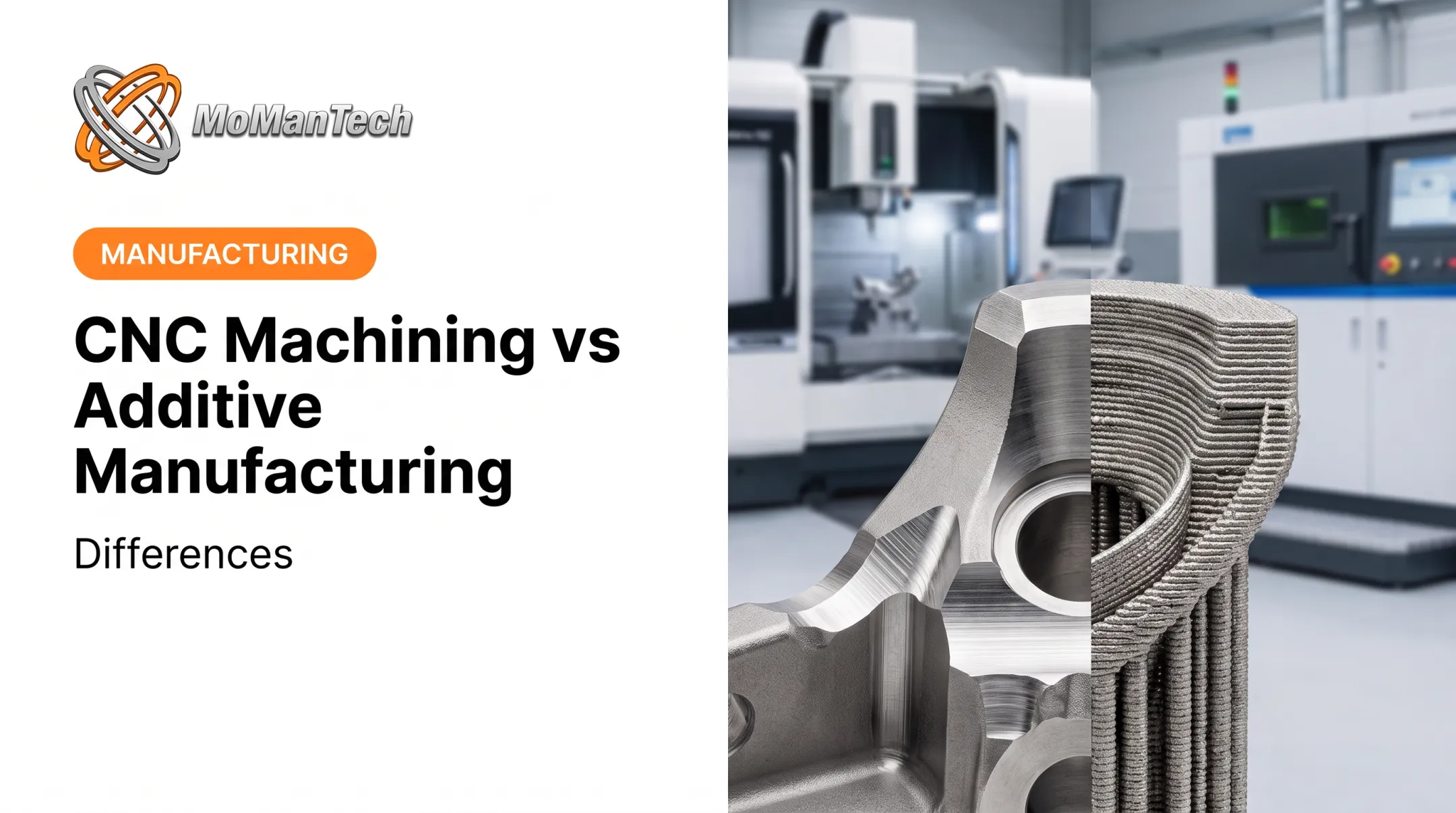
3D printing and CNC machining solve the same problem from opposite directions. One builds a part layer by layer from a digital model. The other starts with solid stock and cuts away everything that isn't the final part.
That difference isn't academic. It shapes material properties, tolerances, surface finish, design freedom, setup costs, lead time, and how well a process scales from one prototype to a production run.
For orthopedic device OEMs, getting this choice wrong can mean failed inspections, inconsistent material properties, or a part that simply can't be reproduced the same way twice.
This article breaks down how each process actually works, where each one wins, and how manufacturers typically move from early prototypes to production-ready components. It covers highly engineered spinal, trauma, joint, and foot/ankle parts where dimensional control and material integrity aren't optional.
Key Takeaways
- 3D printing excels at complex geometries, fast design iteration, and low-volume or one-off parts
- CNC machining delivers tighter tolerances, repeatability, and full material strength from billet stock
- Neither process is universally "better" — geometry, material, tolerances, and volume drive the decision
- Production-ready orthopedic components often favor CNC for traceability and inspection control
- Hybrid workflows combine additive design freedom with subtractive precision when planned correctly
3D Printing vs CNC Machining: Quick Comparison
Manufacturing Method
3D printing is additive. It builds a part layer by layer from a digital model using technologies such as FDM, SLA, SLS, or metal laser powder-bed fusion. Each process family has its own resolution, material options, and finishing requirements.
CNC machining is subtractive. Programmed cutting tools remove material from a solid metal or plastic workpiece until the final geometry emerges. There are no layers and no build orientation to plan around.
Cost Structure
- 3D printing needs minimal tooling, which helps on prototypes, one-offs, and complex geometries—though material, supports, post-processing, and equipment access still drive real cost.
- CNC machining carries upfront programming, fixturing, and tooling costs. Those setup costs spread across larger production runs, which is why repeat quantities often favor machining on a per-part basis.
Precision and Surface Finish
Layer height, print orientation, thermal behavior, and support removal all affect a printed part's dimensional accuracy. Shrinkage during cooling adds another variable.
Published accuracy specs also vary by machine and process. An FDM system and an SLA system are not held to the same tolerance standard, and comparing raw accuracy numbers across printer types can be misleading without matching conditions.
CNC machining benefits from rigid fixturing, controlled toolpaths, and multi-axis capability. That combination generally supports tighter, more repeatable tolerances and smoother as-machined surfaces straight off the machine.
Material Properties and Durability
Not all printed parts behave the same. Strength and consistency depend on the process, material, build orientation, porosity, and layer bonding, plus whatever post-processing (like heat treatment) follows. Treating "3D-printed" as a single material category is a mistake engineers often make.
CNC-machined parts are cut from qualified stock material, which preserves that material's established mechanical properties more directly. The part is only as good as the material selection and the machining process applied to it, but there's no layer-bonding variable to manage.

Speed, Volume, and Waste
- 3D printing sets up fast with minimal tooling, which supports rapid iteration. Print duration, build size, supports, and post-processing can still limit how many parts move through in a day.
- CNC machining takes longer to set up, but cutting is efficient for repeatable parts and batches. Chips and scrap matter less than cycle time, tooling life, and finishing when you tally total part cost.
What Are 3D Printing and CNC Machining?
What Is 3D Printing?
3D printing (additive manufacturing) starts with a CAD model, moves through file preparation and slicing or toolpath generation, then builds the part layer by layer before support removal and finishing.
Process families in this comparison:
- Material extrusion (FDM): Common for functional prototypes and fixtures
- Vat photopolymerization (SLA): Known for fine detail and smooth surfaces
- Powder bed fusion (SLS, metal laser PBF): Used for both engineering polymers and metals like titanium and stainless steel
Each family carries different accuracy, strength, cost, and post-processing demands. Metal additive manufacturing, in particular, is a different conversation entirely from polymer printing.
Where 3D printing earns its keep:
- Rapid prototyping and design iteration
- Part consolidation, internal channels, and lightweight lattices
- Geometries conventional cutting tools can't reach
Where it runs into limits:
- Anisotropic strength that varies with build direction
- Support removal, thermal distortion, porosity, and surface roughness
- Limited materials, build-envelope caps, and the need to validate functional performance before production
Use Cases of 3D Printing
3D printing fits well for:
- Early prototypes and fit-and-form evaluation
- Design validation before committing to tooling
- Custom fixtures for internal manufacturing operations
- Low-volume components and complex, organic geometries
A documented example: DePuy Spine used an in-house metal laser powder-bed system to prototype spinal surgical tools, including benders and extractors. According to EOS, delivery of surgical-tool prototypes dropped from several months to under a week in some cases, with 2,000 prototype parts processed in the first year.
That is a prototyping result, not a finished-implant approval outcome. The distinction matters when evaluating additive manufacturing for orthopedic applications.
MoManTech applies the same approach in additive prototyping. Materials such as 17-4 and 316L stainless steel, beta titanium, and composites like Onyx (1.4 times stronger than ABS) support rapid prototypes and custom internal fixtures before a design moves to machined production.
What Is CNC Machining?
CNC machining uses computer-controlled mills, lathes, Swiss-type machines, and multi-axis equipment to cut programmed toolpaths into a solid workpiece. The typical workflow runs through:
- Design review and material selection
- Design-for-manufacturability analysis
- CAM programming and workholding setup
- Machining, deburring, and finishing
- Inspection and quality documentation

Dimensional control, repeatability, surface finish, and durable engineering materials make CNC machining the default for functional prototypes and small-to-medium production quantities. Inspection and quality documentation lock those results in.
Constraints to plan around:
- Tool access to internal corners and fixturing complexity
- Setup changes between operations, material waste, and tool wear
- Fully enclosed or highly organic geometries that printing handles more easily
Use Cases of CNC Machining
CNC machining is the standard for:
- Precision instruments and surgical tools
- Implant components, plates, and trial components
- Housings and parts requiring controlled dimensions
- Components needing consistent, traceable material properties
Regulated medical-device work goes past geometry alone. Process control, traceability, inspection, and documentation must prove the part meets specification batch after batch.
A documented industrial example: Makino reports that Big River Engineering and Manufacturing machines 77 medical part varieties across aluminum, titanium, stainless steel, and plastic, meeting accuracy requirements from ±0.1 to ±0.03 mm. After switching to a horizontal machining and automation cell, the shop reported a 55-70% throughput improvement over its prior vertical-machining setup.
That figure is one shop's documented result, not a process-wide benchmark. It still shows what a strong machining strategy can deliver.
MoManTech runs comparable multi-axis equipment for orthopedic work, including two 6-axis Mazak Integrex I-150 machines and a 9-axis Quicktech S42ATM, supporting spine, trauma, large-joint, and foot/ankle components under ISO 13485:2016 compliance.
3D Printing vs CNC Machining: What Is Better?
There's no universal winner here. The better process is determined by the part's function and production requirements, not by which technology is newer or more flexible on paper.
The decision factors that actually matter:
- Part geometry and design maturity
- Material, mechanical, and tolerance requirements
- Surface finish and inspection needs
- Production quantity and lead time
- Waste, post-processing, and total lifecycle cost
Choose 3D Printing When
3D printing makes sense for:
- Early-stage design exploration with frequent changes
- One-off or highly customized parts
- Complex internal features impossible to machine conventionally
- Lightweighting and part consolidation goals
- Geometries that would require excessive CNC setups or custom tooling
Metal 3D printing deserves separate evaluation from polymer printing. It involves equipment access, material qualification, build orientation planning, support strategy, heat treatment, machining allowances for critical surfaces, and additional inspection steps.
Choose CNC Machining When
CNC machining is the right call when a part needs:
- Tight, repeatable dimensions across every unit
- Smooth functional surfaces without secondary finishing
- Robust, qualified material properties
- Reliable mating interfaces
- A production process that can be controlled and documented consistently
For orthopedic medical-device OEMs, this is often the deciding factor. Spinal, joint, trauma, and foot/ankle components frequently demand production-ready material integrity, full inspection records, and traceability. CNC machining is built to satisfy those requirements.
Consider a Hybrid Workflow
A 3D-printed near-net-shape part can be CNC-machined afterward at critical interfaces, bores, threads, or mating surfaces where tolerance control matters most. This combines additive design freedom with subtractive precision.
It still requires coordinated design allowances, fixturing plans, inspection protocols, and clear accountability for final quality.
This is where a manufacturing partner's design-for-manufacturability expertise earns its value. An ISO 13485:2016-certified manufacturing partner like MoManTech can help orthopedic OEMs assess whether a design is actually ready for precise, repeatable production, not just whether it looks finished on screen.
Real-World Examples
Complexity and consolidation: GE Aerospace's fuel-nozzle tip previously required assembling roughly 20 welded and brazed pieces. By switching to metal additive manufacturing, GE consolidated the part into a single piece that came in about 25% lighter.
It's an aerospace case, not an orthopedic one. Still, the takeaway holds: printing wins when geometry complexity and part consolidation drive the design.
Precision and production consistency: The Big River medical-machining example cited earlier shows the opposite scenario. That shop chose CNC because dozens of part varieties needed tight, repeatable accuracy across every batch, not just a clever geometry.

The decision lesson: Match the process to the part's functional requirements and production stage. Don't assume one technology replaces the other because it scores better on a single metric.
If your team is weighing this choice for a spinal, trauma, joint, or foot/ankle component, MoManTech works with orthopedic device startups and small-to-mid-size OEMs on manufacturability reviews, prototype-to-production planning, and CNC machining requirements.
Call 406-842-5403 to talk through your design.
Conclusion
Choose 3D printing when:
- The design is still evolving
- Geometry is too complex for conventional cutting
- You need a handful of parts fast without tooling investment
Choose CNC machining when:
- Parts need tight, repeatable tolerances
- Full material strength from qualified stock is required
- Production must be inspected and documented with confidence
These two methods work best as stages in the same journey. A design often starts as a 3D-printed prototype, gets refined through several iterations, and then transitions to CNC-machined production once tolerances, material requirements, and inspection standards are locked in.
Getting that transition right, with a partner that handles both additive prototyping and precision CNC, is what separates a smooth path to production from a costly redesign. MoManTech supports orthopedic device OEMs through both stages, from early prototypes to documented production runs.
Frequently Asked Questions
Can a 3D printer be used as a CNC machine?
Some hybrid industrial systems combine additive deposition with CNC milling and turning in one machine. A standard 3D printer, however, isn't automatically capable of CNC machining. It lacks the rigidity, tooling, controls, and workholding that subtractive processes require.
How much does a 3D CNC machine cost?
Pricing varies widely based on machine size, materials supported, additive and subtractive capabilities, automation, and safety systems. Compare total ownership cost, including software, installation, and maintenance, rather than equipment price alone.
Is CNC harder than 3D printing?
CNC machining demands skills in programming, workholding, tooling selection, and inspection. 3D printing requires its own expertise in orientation planning, slicing, supports, and post-processing. Neither is inherently "easier"; both require trained personnel for industrial-grade results.
What are the 7 types of 3D printing?
Under ISO/ASTM terminology, the seven categories are material extrusion, vat photopolymerization, powder bed fusion, binder jetting, material jetting, directed energy deposition, and sheet lamination. Individual commercial printers often market these categories under different brand names.
What does CNC stand for?
CNC stands for computer numerical control. It refers to programmed digital instructions that control a machine's movement and cutting operations, replacing manual operator control of the equipment.