
If you're a manufacturing engineer, product developer, or medical-device OEM weighing precision machining options, EDM matters because it affects dimensional accuracy, feature complexity, surface integrity, and quality documentation. It shows up in nearly every conversation about CNC and advanced processes, yet few teams understand it at an operational level.
This guide covers how the process works, the machine types, applications, factors that shape results, and the limits that keep EDM from being a default choice.
Key Takeaways
- EDM erodes metal with repeated sparks across a controlled gap, not a cutting edge.
- It suits hardened, conductive materials and intricate features that conventional tools struggle with.
- Wire, sinker, and hole-drilling EDM each produce different geometry.
- Dielectric, flushing, pulse settings, electrode condition, fixturing, and inspection shape the result.
- EDM is precise, but not automatically the fastest or cheapest route.
What Is EDM and Why Is It Used?
What Is the EDM Process?
EDM is a nontraditional, thermal-erosion process. Each discharge melts and vaporizes a microscopic amount of a conductive workpiece. SME's study guide puts local spark temperatures at 14,000-21,000 °F.
The goal is precise profiles, cavities, slots, holes, and fine details without conventional cutting forces.
CNC describes how a machine is controlled, not how it removes material. Conventional machining uses a physical cutting edge. EDM uses electrical energy across a spark gap. Wire EDM is itself CNC-controlled, so "CNC versus EDM" is really "cutting versus spark erosion."

Why Is EDM Used in Precision Manufacturing?
- Low cutting force. With no tool contact, thin or delicate parts see less deflection, vibration, and distortion. Fixturing and flushing forces still matter, and the process still creates localized heat.
- Hard materials. Hardened tool steels, carbide, titanium, and superalloys are all workable when conductive. Medical shops also machine nickel-based alloys, cobalt-chromium, and NiTi.
- Medical features. A 2019 study cut a Ti49.4Ni50.6 shape-memory alloy dynamic compression plate by wire EDM. Wire EDM also produces instrument jaw profiles, slots, and guide openings.
- Fewer burrs. Cutting-tool burrs are largely avoided, but recast material, particles, and sharp edges can still need finishing.
EDM is not mandated by regulation. FDA's QMSR, effective February 2, 2026, incorporates ISO 13485:2016 and addresses production controls, conformity, and validation where results can't be fully verified. Process choice comes from design requirements, material, customer specifications, and validated processes.
How the EDM Process Works
A power supply sends pulsed discharges between an electrode (or continuously fed wire) and the workpiece. The gap is small, roughly 0.001 in by SME's illustration, and sits in a dielectric fluid.
Required inputs include:
- Conductive workpiece
- Electrode or wire
- Power supply and dielectric
- Flushing system and CNC controls
- Workholding and programmed geometry
The Discharge Cycle
- The dielectric insulates the gap.
- Voltage builds until the fluid breaks down locally and a plasma channel forms.
- Heat melts and vaporizes a tiny portion of the workpiece.
- Current stops, the channel collapses, and fluid flushes debris away.
- The cycle repeats.

Sodick describes discharge repetitions in the tens to hundreds of thousands per second, with pulse durations from microseconds to milliseconds depending on the circuit. Treat these as circuit-specific examples, not universal settings.
Servo control keeps the gap stable by adjusting electrode or wire position. This prevents short circuits and unstable arcing.
The Resulting Surface
Every pulse leaves a crater. Metal that melts but isn't expelled can resolidify as a recast (white) layer, with a heat-affected zone beneath it.
Roughing passes prioritize removal. Lower-energy finishing passes shrink craters and roughness.
In a 2023 Ti6Al4V experiment, four finishing cuts reduced Sa from 6.74 to 0.8 µm. That result is specific to the material and conditions tested.
Step 1: Setup and Workholding
The operator secures and aligns the workpiece, sets work coordinates, checks the drawing or CAD data, and picks the electrode, wire, or tube.
Stable fixturing matters even without cutting force. Flushing pressure, overhang, and vibration all cause accuracy problems. Thin features need protection, and the machining zone needs clear access.
Step 2: Dielectric Application and Flushing
The dielectric insulates the gap until breakdown, cools the zone, and carries eroded particles away.
- Wire EDM: usually deionized water.
- Sinker EDM: commonly hydrocarbon or silicone oil, with the part submerged.
- Hole drilling: a rotating tube electrode with high-pressure flushing.
Step 3: Spark Generation and Material Removal
Repeated discharges erode the part along the electrode shape or programmed wire path. Pulse energy, duration, current, polarity, gap, and frequency set the tradeoffs.
Higher energy removes more per pulse but leaves larger craters and a rougher surface. Polarity affects electrode wear.
No single recipe works across materials and generators, so parameters come from the machine builder and qualification runs.
Step 4: Gap Control, Finishing, and Inspection
The machine monitors the gap continuously and adjusts motion and electrical conditions. After roughing, skim passes bring the part to size and finish.
Then comes cleaning, dielectric residue removal, dimensional and surface inspection, and documentation.
Dimensional acceptance alone doesn't prove cleanliness or surface integrity.
Where the EDM Process Is Applied
Three Machine Types
| Type | Electrode | Typical output |
|---|---|---|
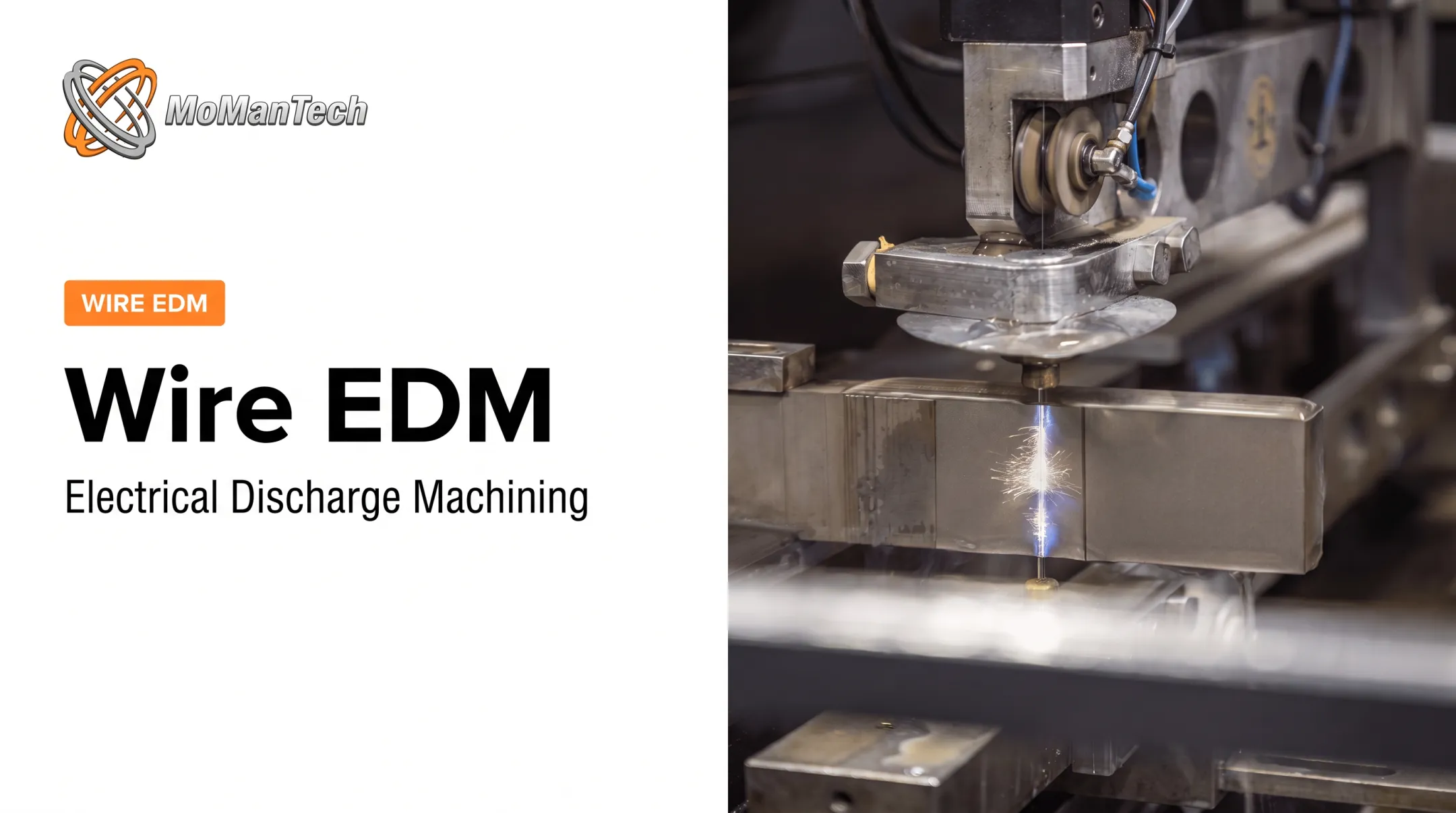
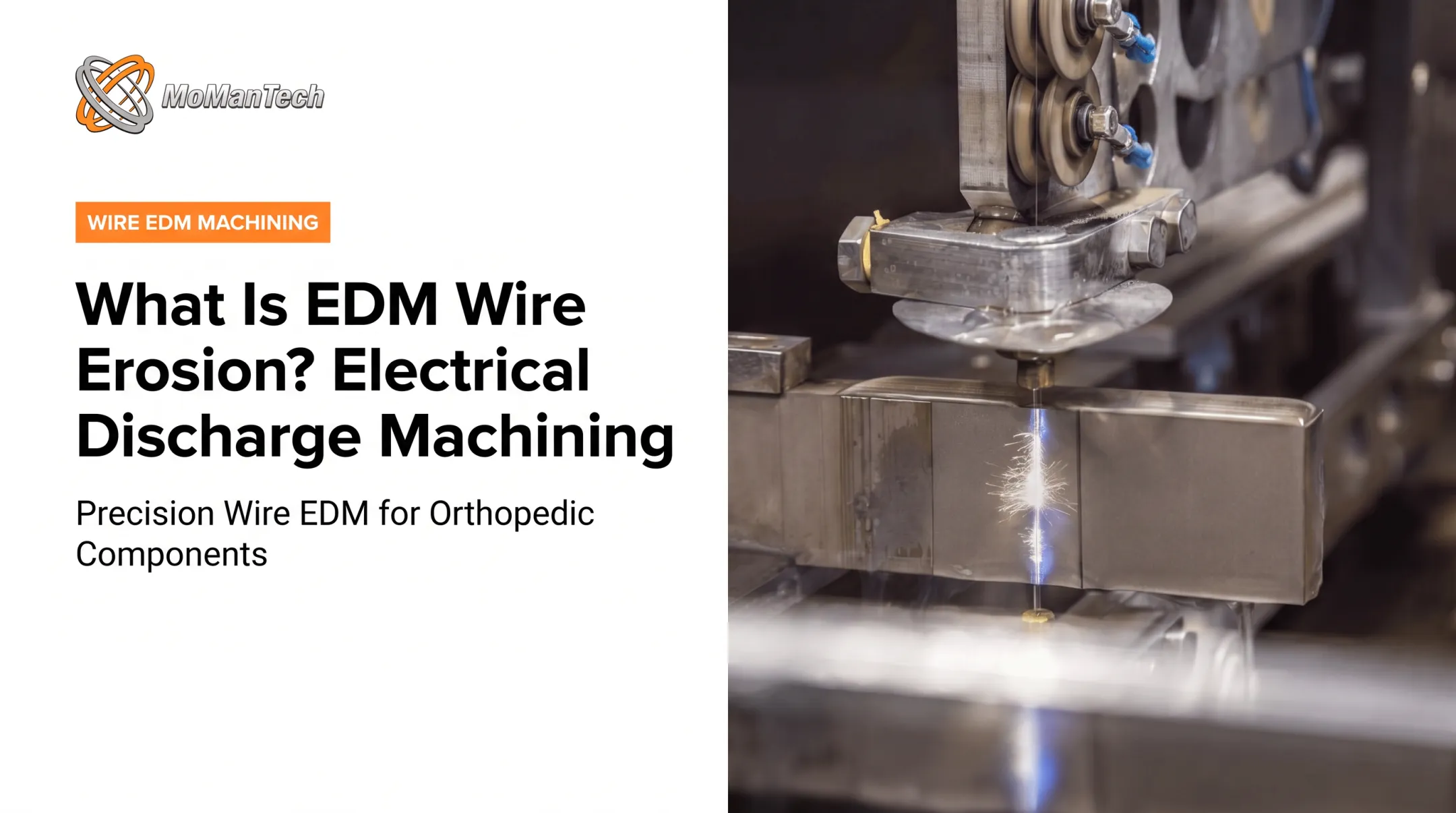
| Wire EDM | Continuously fed wire | Through-profiles, slots, contours |
| Sinker (ram) EDM | Shaped electrode | Blind cavities, 3D details |
| Hole-drilling EDM | Rotating tube | Small, deep holes, wire start holes |
Wire EDM is primarily a through-cutting process, so enclosed profiles need a start hole. Blind cavities call for sinker EDM.
Lifecycle and Industry Uses
EDM appears in prototyping, first articles, production, tooling and fixtures, repair, and secondary features. Typical triggers:
- Hardened material
- Narrow slots or sharp internal details
- Deep, small holes
- Fragile geometry or low allowable cutting force
Examples by industry:
- Medical: instrument profiles, orthopedic plates, tooling and gauges
- Aerospace: turbine blade film-cooling holes
- Automotive: prototype punch, die, and blank-holder sets cut together (Mitsubishi customer example)
- Electronics: small-hole and micromachining work
- Repair: gas turbine vane repair (Sulzer)
EDM often pairs with CNC. Milling or turning removes bulk material, then EDM produces the features that need it.
A Note for Orthopedic OEMs
MoManTech is an ISO 13485:2016-certified contract manufacturer focused exclusively on orthopedic devices. Its precision CNC offering includes milling, turning, multi-axis Swiss, and wire EDM. If you're evaluating an EDM-related feature, talk with the team about design for manufacturability, prototype-to-production machining, inspection, and process selection.
Key Factors, Common Issues, and Misconceptions
Key Factors That Affect the EDM Process
- Material: Conductivity enables the process, not hardness. Melting point, thermal conductivity, alloy, and thickness change behavior.
- Operating conditions: pulse energy, duration, current, polarity, gap, flushing, and dielectric condition drive accuracy, removal rate, and recast.
- Equipment: rigidity, servo control, power supply, wire quality or electrode wear, filtration, calibration, and inspection tools.
- Scale: EDM suits prototypes, low volumes, and intricate repeatable work; bulk removal often favors faster processes. Makino notes EDM can be slower than conventional machining, though an accurate rough pass may reduce later skim passes.
- Safety and quality: Electrical energy, hot debris, and dielectric handling need training and maintenance. Oil dielectrics raise fire and mist risks; water-based systems can cause residual-current electrolysis, discoloration, or corrosion. ISO 28881:2022 covers EDM machine safety, and medical work adds traceability and documentation.
Common Issues and Misconceptions
- "EDM is heat-free." It avoids cutting forces but is thermal. Recast layers, heat-affected zones, and microcracking can occur.
- "Burr-free means defect-free." Micro-craters, residue, oxidation, electrode wear, and wire breaks all happen. Cleaning and verification still apply.
- "Nonconductive materials are off limits, period." Ordinary plastics, glass, and most ceramics can't use standard EDM. A 2023 review describes conductive coatings and assisting electrodes for insulating ceramics, but that remains specialized work. Conductive ceramics and composites are separate cases.
- "EDM beats CNC every time." Accuracy, cost, and speed depend on geometry, material, tolerance, quantity, setup, and secondary operations.
- "EDM and ECM are the same." EDM erodes by spark-driven thermal action in a dielectric. ECM dissolves metal electrochemically in an electrolyte, with different tooling and controls.
When EDM May Not Be Appropriate
EDM is inefficient for:
- Large material removal
- Simple open geometries
- High-throughput work that milling or turning finishes faster
- Parts that can't be fixtured without distortion
Material matters too. Nonconductive workpieces rule it out, and applications that can't tolerate recast material need added finishing.
Alternatives by requirement:
- Milling or turning: faster bulk removal, and better for rotational features
- Grinding or polishing: specific surface requirements
- Laser drilling: faster small-hole work in hard alloys, with thicker recast than EDM
- ECM: electrochemical removal for conductive parts when thermal damage is unacceptable
One 2016 study drilled 0.8 mm holes through 10 mm nickel alloy in under 3 seconds versus 48 seconds for the best EDM condition, with recast of roughly 80 µm for laser versus 10-15 µm for EDM. Results are machine- and material-specific.

Decision Checklist
Before choosing EDM, ask:
- Is the material conductive?
- Does the geometry need through-cuts, cavities, or small deep holes?
- How small are the features, and how tight is the tolerance?
- What surface finish and surface integrity are required?
- What quantity and lead time apply?
- What inspection and cleaning are needed?
- What post-processing follows, and what is the total process cost?
If conventional machining meets every answer, use it.
Conclusion
EDM removes conductive material through controlled discharges across a dielectric-filled gap. The electrode shape or programmed wire path defines the feature.
The process suits:
- Hardened materials and complex geometry
- Delicate features and precision medical components
Results still depend on parameter control, flushing, workholding, surface-integrity management, and inspection.
Select the process deliberately. Compare EDM with CNC, ECM, drilling, laser, and grinding against the part's material, geometry, volume, and quality requirements.
Frequently Asked Questions
How does electrical discharge machining work?
A pulsed power supply creates sparks across a small gap filled with dielectric fluid. Each spark melts and vaporizes tiny amounts of metal, and flushing removes the debris. CNC servo control holds the gap steady.
What is electric discharge machining?
EDM is a non-contact process for machining electrically conductive workpieces. It uses repeated electrical discharges between an electrode and the part to erode material.
Which material cannot be machined by EDM?
Conventional EDM generally can't cut nonconductive materials such as ordinary plastics, glass, and most ceramics. Conductive coatings or conductive ceramics are exceptions that need separate evaluation.
What is the difference between CNC and EDM?
Conventional CNC cutting uses a physical tool, while EDM erodes material with sparks and applies negligible cutting force. EDM handles hard conductive metals and fine features but can be slower, and may need finishing for recast layers.
What is EDM and ECM?
EDM removes material by spark-driven thermal erosion in a dielectric fluid. ECM dissolves conductive material electrochemically using an electrolyte.
What is wire EDM (wire-cut electric discharge machining)?
Wire EDM feeds a thin wire continuously through a conductive workpiece, eroding material by spark. It makes precise through-cuts, slots, profiles, and intricate contours in materials like tool steel, titanium, and carbide.