
Introduction
A distal fibula fracture near the ankle can displace in ways that threaten joint mechanics if left uncontrolled. One fixation option surgeons consider is the antiglide plate, a construct positioned to resist fragment sliding rather than simply span the break.
Clinicians weighing fixation options and orthopedic device OEMs building these plates face different but related questions. Surgeons need to understand when the biomechanics support this approach. Manufacturers need to understand what design and process requirements turn that biomechanical intent into a reliable, repeatable implant.
This article covers how antiglide plates function, when they may be considered, how they compare with other fibular fixation methods, and what OEMs should evaluate during development.
Key Takeaways
- Antiglide plates sit on the posterior or posterolateral fibula, buttressing against fragment translation rather than general stabilization
- Fracture morphology, bone quality, soft-tissue status, and surgeon judgment determine whether the construct fits a given injury
- Current research compares fixation methods carefully rather than confirming one technique as universally superior
- Contour accuracy, screw-hole precision, low-profile geometry, and process control drive both implant performance and manufacturability
What Is an Antiglide Plate for Fibula Fractures?
Plate fixation isn't a single mechanical idea. Depending on how it's applied, a plate can neutralize load on a lag screw, compress a fracture, bridge a comminuted segment, or buttress a fragment against displacement, according to the AO Foundation's surgical reference. An antiglide plate is a specific application of that last category.
For distal fibula and lateral malleolus fractures, the construct is typically a one-third tubular plate placed posterolaterally. Tightening the plate draws it against bone and applies compression to the distal fragment, indirectly reducing the fracture as it's seated.
Fracture Patterns Discussed in the Literature
The patterns most often associated with antiglide plating include:
- Short-oblique fractures extending proximally from the syndesmotic level
- Weber type B injuries, where the fracture line starts at the tibial plafond
- Supination-external-rotation (SER) patterns in the Lauge-Hansen sequence, with oblique fibular fracture and sometimes medial involvement
Classification and treatment selection require imaging and a clinical exam. These labels describe fracture mechanics, not a treatment decision made from a label alone.
Why Length, Alignment, and Rotation Matter
Restoring fibular length and rotation isn't cosmetic. Cadaver research has shown that fibular shortening or external rotation reduces dynamic tibiotalar contact, an effect that worsens with deltoid ligament disruption. Rotational malreduction similarly alters ankle-joint contact pressures.

The term antiglide plate refers specifically to placement and mechanical function, not any plate put on the fibula. A plate on the lateral surface serves a different biomechanical role than one positioned posteriorly to resist sliding.
How Antiglide Plates Work and When They May Be Used
The antiglide principle is straightforward in concept: place the plate on the side of an oblique fracture where it physically blocks the fragment from sliding under load. As the fracture line often runs from distal-anterior to proximal-posterior in SER-type injuries, a posterolateral plate sits directly in the path of that displacement.
How the Construct Comes Together
Several elements interact to produce a functional buttress:
- Plate contour - a slight bend at the distal end, with the central section left straight, so tightening generates compression against the fragment
- Screw placement - AO technique places the nearest proximal hole 3-5 mm from the fracture line, with a through-plate lag screw as close to perpendicular as anatomy allows
- Distal extent - positioning the plate's lower end too far distally can tilt the malleolar fragment anteriorly instead of stabilizing it
- Reduction quality - the buttress effect depends on accurate plate position, not screw count alone
There's no universal screw configuration here. Fracture geometry, bone quality, and surgeon technique all shape the final construct.
What the Evidence Actually Shows
Two clinical reports are frequently cited in this space. Their endpoints differ, so the numbers need careful reading.
A 2021 series followed 24 patients treated with posterior antiglide fixation for closed Weber B/SER fractures, reporting no nonunion and hardware removal in 4 patients (16.6%) over at least one year of follow-up. It didn't quantify fibular-length maintenance as a specific endpoint.
A 2025 retrospective comparison in BMC Musculoskeletal Disorders looked at 59 patients: 28 treated with antiglide plating, 31 with nitinol staples. All 28 plate cases achieved union, with no reported shortening.
Implant discomfort was reported in 20 of 28 plate cases (71.4%) versus 10 of 31 staple cases (32.3%). Removal occurred in 75% of plate cases versus 35.5% of staple cases, with mean follow-up of 13.4 months.
That study excluded syndesmotic injury, pilon fractures, and certain comminuted patterns, so its findings shouldn't be generalized beyond that population.
Biomechanical testing adds another layer, and it doesn't point in one direction:
| Study | Model | Finding |
|---|---|---|
| Minihane et al., 2006 | Osteoporotic short-oblique, 18 paired ankles | Antiglide showed greater torque to failure and stiffness than lateral locking plates |
| Switaj et al., 2016 | Osteoporotic, 16 specimens | A modern lateral locking construct outperformed antiglide in torsional loading |
| Deng et al., 2022 | Meta-analysis, 76 cadaveric ankles | No significant pooled difference in torque to failure |

Osteoporotic bone performance appears construct-dependent, not settled. Fracture obliquity, comminution, syndesmotic involvement, soft-tissue condition, and the need for additional fixation all influence whether a surgeon selects this approach.
Postoperative weight bearing and rehabilitation timelines vary by injury severity and fixation stability. Patients should direct recovery questions to their treating surgeon rather than expect a standard timeline.
Antiglide vs Other Fibular Fixation Options
Antiglide vs Lateral Neutralization Plating
Both approaches can stabilize the same fracture types, but they work differently. Lateral plating sits on the fibula's lateral surface; antiglide plating sits posterolaterally, buttressing against fragment slide rather than neutralizing load on a separate lag screw.
A 2022 meta-analysis pooling 1,122 patients across nine clinical studies found posterior plating associated with lower hardware removal odds (OR 2.48) and lower discomfort odds (OR 2.96) compared with lateral plating. Infection and peroneal-irritation rates didn't differ significantly between the two.
Antiglide vs Buttress Plate: A Terminology Note
These terms get used interchangeably, but they're not quite the same thing:
- Buttress plate is a broad mechanical description: any plate supporting a fragment against displacement
- Antiglide plate is a specific application of buttressing, where placement resists a fragment sliding along an oblique fracture line
Every antiglide plate functions as a buttress. Not every buttress plate qualifies as an antiglide construct.
Antiglide vs Lag-Screw-Only, Nails, and Staples
- Lag-screw-only fixation: Mechanical comparisons use neutralization plates on noncomminuted, long-oblique patterns, not antiglide constructs. No direct antiglide comparison has been established.
- Intramedullary fibular nails: Comparisons test nails against locking plate-and-screw constructs, not posterior antiglide plating. Antiglide-specific advantages over nailing remain unestablished.
- Nitinol staples: The 2025 comparison above found staples needed a smaller incision (3.8 cm vs 8.7 cm) and lower discomfort and removal rates, with important exclusions and short follow-up.
One additional distinction matters for anyone reading the broader literature: a "true" antiglide plate without distal-fragment screws differs from a posterior neutralization plate that does use distal screws.
A 2022 study in Injury comparing 33 true antiglide constructs against 63 posterior neutralization constructs found hardware removal at 15.2% versus 38.1% respectively. That gap is easy to miss when all posterior plating is treated as one category.

Limitations Worth Weighing
- Fracture comminution and osteoporosis change which construct performs best mechanically
- Syndesmotic injury often requires additional fixation beyond the fibula plate itself
- Soft-tissue condition can dictate timing and approach regardless of construct choice
- Surgeon experience and technique influence outcomes in ways that are hard to isolate in retrospective studies
- Prominent distal screws near the peroneal tendons have been linked to tendon lesions in some removed-hardware cases, so posterior placement is not automatically risk-free
Design and Manufacturing Considerations for OEMs
Translating antiglide biomechanics into a manufacturable implant means converting clinical intent into measurable specifications and then verifying those specifications hold up part after part.
Design Inputs That Need Validation
Design teams typically work through:
- Anatomical contour matched to the posterolateral fibula surface
- Plate thickness and working length appropriate for the intended fracture zone
- Hole spacing and screw compatibility, including trajectory for a through-plate lag screw
- Edge profile and radius transitions that reduce soft-tissue irritation
- Low-profile geometry to limit prominence near the peroneal tendons
Some of these are validated against a specific device specification; others are general design considerations that get refined through prototyping. Keeping that distinction clear avoids treating a working assumption as a tested requirement.
Manufacturability Issues on the Shop Floor
Machining a small, contoured, thin-section plate brings its own challenges:
- Tool access around complex contours without compromising hole geometry
- Thin-section stability during machining to prevent distortion or chatter
- Burr prevention, particularly near screw holes and edge transitions
- Fixturing and datum strategy that stays consistent across a production run
- Repeatable contouring so every plate matches the approved anatomical profile
- Tolerance control on screw holes, since fit directly affects plate-to-bone contact
Material and surface requirements matter just as much. That includes material traceability, corrosion and biocompatibility performance, surface finish, and any specified passivation or finishing process , all verified against the approved device specification rather than assumed.
Inspection and Quality Controls
A trauma implant like this typically requires:
- Dimensional inspection of contour, thickness, and hole geometry
- Hole and thread verification against print tolerances
- Visual inspection for surface defects
- Cleaning and packaging process inputs
- Lot traceability and documented nonconformance prevention
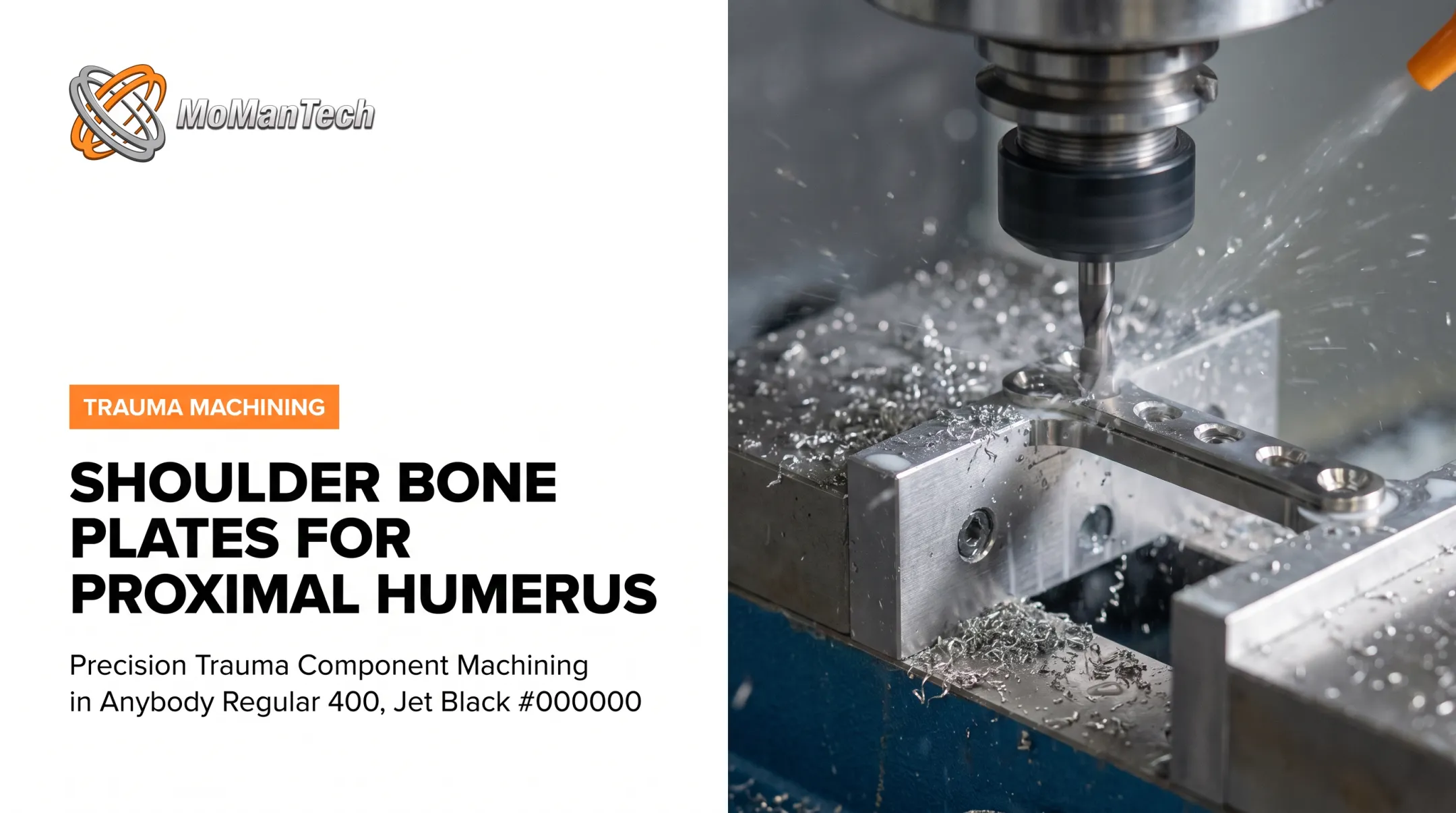
This is where MoManTech's role fits in. As an ISO 13485:2016-certified contract manufacturer working exclusively with orthopedic OEMs, MoManTech supports design-for-manufacturability input during planning, produces prototype and first-article quantities before committing to volume, and runs precision CNC milling, turning, and wire EDM for trauma and foot/ankle components.
Inspection equipment, including an OGP Flash 302 vision system with CMM and laser measurement, supports the dimensional and contour verification these plates require. MoManTech does not validate clinical performance or take on the OEM's regulatory responsibilities; those stay with the device company. It does provide the manufacturing precision and documentation those regulatory submissions depend on.

A Practical Development Workflow
- Define clinical and regulatory requirements before finalizing geometry
- Review manufacturability early, ideally alongside the design team rather than after drawings are locked
- Produce prototypes or first articles in small quantities to test fit, contour, and screw compatibility
- Verify dimensions and processes against the approved specification
- Complete design validation through the appropriate regulatory and clinical pathways
- Establish controlled production documentation before scaling to full production runs
Frequently Asked Questions
How long does it take to recover from distal fibula plate surgery?
Recovery varies with fracture severity, associated ankle injuries, fixation stability, bone health, and the surgeon's specific weight-bearing protocol. There's no universal timeline. Ask your treating surgeon about your individual recovery plan.
How does an antiglide plate work?
Posterior or posterolateral placement lets the plate act as a physical buttress against an oblique fibular fracture, resisting fragment translation under load. This works when the construct is selected for the right fracture pattern and applied with accurate reduction.
What is the difference between an antiglide plate and a buttress plate in bone fixation?
"Buttress plate" is a broad mechanical term for any plate supporting a fragment against displacement. "Antiglide plate" commonly refers to a specific buttress-style plate positioned to resist a fragment sliding along an oblique fracture line.
When is an antiglide plate used for a fibula fracture?
Selection depends on fracture pattern, location, displacement, comminution, bone quality, syndesmotic stability, and soft-tissue condition. It's one option among several, not a default choice for every distal fibula fracture.
What should OEMs consider when designing an antiglide fibula plate?
Key factors include anatomical contour, low-profile geometry, screw-hole tolerances, material and finishing requirements, and dimensional inspection. Early design-for-manufacturability review and documented traceability support both quality and regulatory submissions.