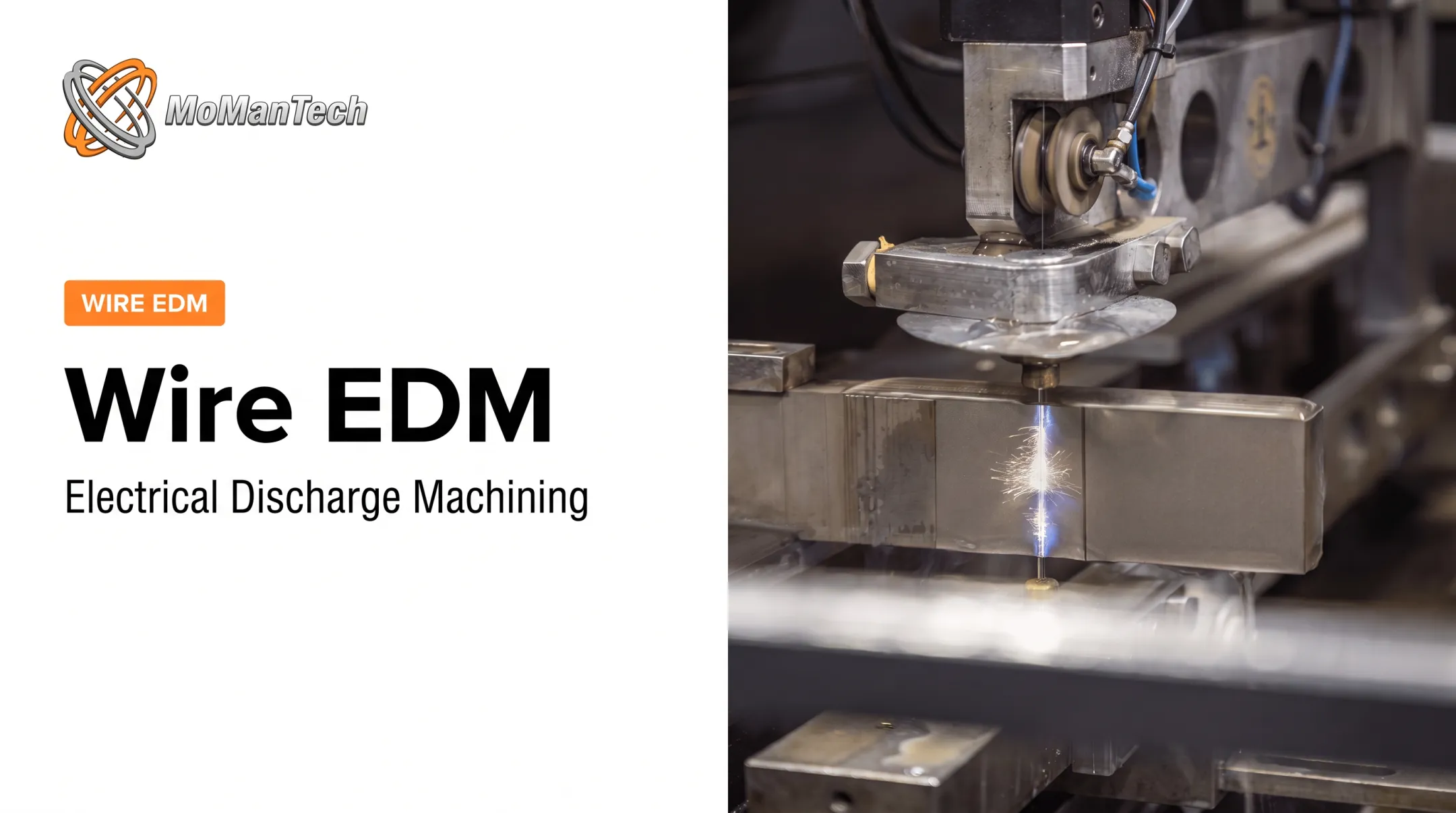

Many buyers struggle to understand why two seemingly similar parts can carry very different quotes. Outsourced US wire EDM pricing swings widely based on job complexity, quantity, material, tolerance, surface finish, and the capabilities of the supplier you choose.
This article walks through typical pricing structures, the cost components hiding inside a quote, the variables that move the number up or down, and how to budget realistically. We'll also look at when wire EDM makes sense versus alternative processes like CNC milling or sinker EDM.
Key Takeaways
- Quotes typically combine setup/programming, machine time, consumables, inspection, and post-processing charges.
- Thickness, cut length, tolerance, surface finish, taper, and pass count all push price up or down.
- Prototype and first-article runs carry higher per-part costs since fixed setup work spreads across fewer units.
- The lowest hourly rate rarely equals the lowest total cost once hours, scope, and rework risk are factored in.
How Much Does Wire EDM Cost?
There's no universal fixed price for wire EDM work. Suppliers quote by machine hour, by estimated job total, per part, or through a blended structure that bundles setup with runtime.
Here's the honest answer: no single, current, publicly verified benchmark exists for outsourced US wire EDM hourly rates that separates general job-shop work from high-precision or regulated machining.
Rates depend heavily on machine capability, region, material, automation level, and the labor backing the job. Any shop quoting a flat number without understanding your print is guessing.
Instead of chasing a single number, focus on the pricing framework behind a quote.
Prototype or One-Off Work
Programming, setup, fixturing, starter holes, and inspection dominate the cost here because there's no quantity to spread those fixed costs across. A single bracket might take an hour to cut but three hours to program and fixture correctly.
Small-Batch Production
Setup costs get distributed across multiple parts. If a shop saves your program and fixture design, repeat orders often cost less per part than the first run did.
Higher-Volume or Automated Work
Stacking blanks, automatic wire threading, and unattended cutting can lower cost per part. One medical manufacturing example describes stacking 400 sheets of 0.005-inch stainless shim to cut 400 parts along a single programmed wire path.

That approach works when geometry and tolerance requirements allow it.
A quote may or may not include:
- Raw material and material certification
- Programming, setup, and fixturing
- Wire, deionized water, filters
- Inspection reports and documentation
- Deburring, cleaning, tab or slug removal
- Freight, taxes, and expedited delivery
Don't compare hourly rates in isolation. A $100/hour shop estimating four hours beats a $75/hour shop estimating six. Always ask for estimated hours, pass count, and inspection scope alongside the rate.
Key Factors That Affect Wire EDM Cost
Machine time and labor usually form the largest share of an outsourced quote, but several technical and operational factors determine how much machine time a part actually requires.
Type or Configuration of the Part
A straightforward through-profile cuts faster than a part requiring tapered cuts, multi-axis paths, small internal radii, or multiple setups. Each additional feature adds programming time and cutting passes.
Material, Thickness, and Cut Length
Wire EDM requires electrically conductive material. Thickness, total cut length, conductivity, and flushing conditions all affect feed rate and cycle time. Hardness alone doesn't predict cutting speed.
| Material | Reported thermal conductivity | Cutting implication |
|---|---|---|
| Titanium alloys | 6–22 W/m-K | Low conductivity is associated with slower material removal |
| Stainless steels | 15–30 W/m-K | Generally faster cutting than low-conductivity titanium |

Research on low-conductivity materials in wire EDM notes that titanium's resistance to discharge, not its hardness, drives slower cutting. That distinction matters when quoting orthopedic implant materials like titanium alloys versus stainless steel instrumentation components.
Tolerance, Surface Finish, and Number of Passes
A rough cut moves fast. Each skim pass after it improves dimensional accuracy and finish, but adds time. Trade data on wire EDM speed, accuracy, and finish notes that achieving 4–5 microinches Ra can require six or seven skim cuts after roughing.
Specify tight tolerances and fine finishes only where the feature's function demands it. Blanket precision across every surface adds cost without improving part performance.
Setup, Programming, Fixturing, and Starter Holes
Setup-related work includes:
- CAD/CAM preparation and wire-path planning
- Alignment, workholding, tabs, and slug retention
- Custom fixtures and internal starter holes
These costs hit prototypes and small batches hardest; there's no volume to absorb them. Reusable fixtures and saved programs reduce costs on repeat orders.
Quality, Documentation, and Lead-Time Requirements
First-article inspection, full dimensional reports, material traceability, and process documentation all add cost. Medical-device buyers often value documented quality and repeatability over the lowest nominal rate. Not every wire EDM supplier carries ISO 13485:2016 certification, so confirm that credential before you award the work.
Wire EDM Cost Breakdown and Quote Comparison
Reviewing a quote line by line helps you see where the money actually goes.
Initial Setup and Programming
This one-time (or batch-level) work typically covers:
- Drawing review and toolpath programming
- Fixture prep and workpiece alignment
- Program prove-out
- Tab and cutoff planning
Machine Time and Runtime Assumptions
Runtime depends on cut length, thickness, feed conditions, pass count, wire diameter, taper, and whether blanks are stacked. Compare quotes using the same math: hourly rate × estimated hours, not rate alone.

Wire, Dielectric Water, Filters, and Other Operating Costs
Wire is continuously consumed during cutting. These operating costs are often folded into the hourly rate—confirm what is included rather than assuming it:
- Deionized water and resin
- Filters
- Routine machine maintenance
Inspection, Post-Processing, and Handling
Possible additional charges include:
- Deburring and cleaning
- Tab or slug removal
- Dimensional inspection and surface-finish verification
- Certificates of conformance
- Packaging and freight
Low-Cost versus High-Cost Quotes
Once line items are clear, judge the full quote—not just the bottom number. A lower bid isn't automatically the better deal. Compare quotes across:
- Machine capability and process stability
- Inspection depth and documentation
- Lead time and delivery reliability
- Maintenance condition of the equipment
- Automation (threading, stacking, unattended runs)
- Rework risk if tolerances are missed
A premium is worth paying only when it delivers something your project actually needs—documented traceability and inspection depth for a regulated orthopedic component, for instance, versus a simple non-critical bracket.
Quote-comparison checklist — require suppliers to state:
- Quantity and material source
- Thickness and tolerance zones
- Surface finish and pass count
- Inspection scope and documentation
- Delivery timeline and assumptions
- Who supplies fixtures or programming
How to Estimate the Right Budget for Wire EDM
Start with your part's functional requirements and expected workload, not the lowest hourly rate you can find.
RFQ Checklist
A complete request for quote should include:
- Current CAD model and 2D drawing
- Material type and condition
- Blank size and quantity
- Tolerance zones and surface finish
- Taper and starter-hole requirements
- Inspection documentation needed
- Target delivery date
- Whether material or fixtures are customer-supplied
Wire EDM vs. Other Processes
| Process | Best suited for |
|---|---|
| Wire EDM | Conductive, hardened, intricate, low-distortion through-features and tight internal details |
| CNC milling or laser cutting | Suitable materials, simpler geometry, larger quantities, less demanding tolerances |
| Sinker EDM | Blind cavities, deep ribs, and 3D features a wire can't produce |
Common Costly Mistakes to Avoid
Buyers frequently lose money by:
- Focusing only on the hourly rate while ignoring setup hours, pass count, and inspection charges
- Applying tight tolerances or fine finishes to non-functional features
- Overlooking design changes that cut cost — larger internal radii, fewer setups, stackable profiles
- Skipping traceability and documentation requirements until a regulated part fails audit
- Comparing suppliers without checking machine condition, threading automation, or rework policy
For orthopedic device OEMs, this is where manufacturability conversations pay off.
If you're evaluating a machining partner for spine, trauma, large-joint, or foot-and-ankle work, MoManTech can cover manufacturability, inspection expectations, and prototype-to-production planning under ISO 13485:2016. Have that conversation before the quote, not after.
Before you approve the lowest bid, confirm the supplier can support repeat production, first articles, documented inspection, and volume changes as your program scales.
Conclusion
Wire EDM cost is a combination of several drivers:
- Setup and programming
- Machine hours
- Material and consumables
- Inspection, post-processing, and delivery
The biggest design levers you control are:
- Thickness, cut length, and geometry
- Tolerance, surface finish, and taper
- Quantity and pass count
A strong quote balances technical performance, documented quality, delivery reliability, and lifecycle value for your part. The lowest initial number rarely covers all four.
If you are pricing wire EDM for orthopedic device components, MoManTech can help you weigh these tradeoffs against ISO 13485-certified production and documented inspection.
Frequently Asked Questions
How much does wire EDM cost per hour?
US hourly rates vary by machine capability, region, material, precision, and automation level. No single benchmark fits every shop, and total job cost depends on hours and setup as much as the rate.
How much does wire EDM wire cost?
Wire cost depends on diameter, material, coating, and spool size, with consumption tied to cutting hours. Most suppliers bundle wire into their hourly or job rate, so confirm this directly in your quote.
How do wire EDM machines work?
A continuously fed conductive wire uses controlled electrical discharges in deionized water to erode a conductive workpiece along a CNC-programmed path. No mechanical contact is involved.
What is a CNC wire cut machine?
A CNC wire cut machine is another name for a wire EDM machine. Computer-controlled guides move the wire to create precise through-cuts and, on suitable machines, tapered or multi-axis profiles.
What are the two types of EDM machines?
Wire EDM and sinker (ram) EDM are the two primary categories. Wire EDM produces through-cuts, while sinker EDM uses a shaped electrode to create cavities and blind features.