
The stakes go beyond tight numbers on a drawing. A component destined for a spinal construct or a trauma plate has to perform identically whether it's part number one or part number one thousand. That means dimensional accuracy, material traceability, and process consistency all have to work together.
This article covers what "precision" actually means in medical machining, the applications and materials involved, how the manufacturing workflow runs end to end, the documentation OEMs should expect, how production scales from prototype to repeat orders, and what to look for when vetting a contract manufacturing partner.
Key Takeaways
- Precision depends on repeatability, documented processes, and material traceability, not just drawing tolerances.
- Scale from one-off prototypes to 100+ unit runs without dedicated hard tooling.
- Match tolerance, material, and inspection requirements to each part's function and risk level.
- Bring a machining partner in early for design-for-manufacturability feedback to smooth the prototype-to-production path.
What Makes Medical CNC Machining "Precision"?
CNC equipment follows programmed CAD/CAM toolpaths, removing material the same way every time a program runs. But the machine is only part of the story. Machinists and quality personnel control setup, tooling, workholding, and inspection—the variables that decide whether a "precise" program yields a conforming part.
Tolerances Should Match Function, Not Habit
Every nominal dimension, tolerance, and geometric relationship (position, concentricity, flatness) should trace back to how the part functions in the finished device. ASME Y14.5-2018, reaffirmed in 2024, standardizes GD&T symbols and rules—but it does not set a universal tolerance for orthopedic parts. That call belongs to the design team and the part's intended use.
Orthopedic components often combine several demanding features in one part:
- Curved or contoured surfaces that mate with anatomy or other hardware
- Threaded holes and precision bores
- Slots and mating interfaces that must align across an assembly
- Small features with tight positional requirements relative to each other
Repeatability Across Lots
A part that measures perfectly once isn't enough. It needs to measure the same way across prototype builds, first articles, and every production lot after that, including after a design revision or a process tweak. That consistency is what separates a one-off from a production-ready process.
Design-for-Manufacturability Review Catches Problems Early
A DFM review before production often flags issues such as:
- Tolerances tighter than the application actually requires
- Tool access problems on deep or recessed features
- Thin walls prone to distortion or chatter
- Burr-prone edges that complicate finishing
At MoManTech, DFM consultation sits in the planning stage so tool access, wall thickness, and tolerance stack-ups get resolved before they stall a build.
Precision also covers non-dimensional controls: material certifications, revision control, inspection records, and documented acceptance criteria. For a regulated device, a part with perfect dimensions but no traceable material certificate is still an incomplete deliverable.

Applications and Materials for Precision Medical Components
Orthopedic component manufacturing spans several device categories, each with its own feature complexity and tolerance demands:
- Spinal components — rods, plates, connectors, and related instrument components
- Joint and large-bone components — plates, housings, and associated hardware
- Trauma components — fixation hardware and related parts
- Foot-and-ankle components — smaller, often more intricate geometries
CNC machining supports both early-stage development and repeat production. A startup might need five prototype units to validate a design, while an established OEM might need a steady 100+ unit production run on a recurring schedule. The same machining process can serve both, which matters for OEMs that don't yet know their long-term volume.

Material Selection Depends on the Application
Commonly selected material categories include:
| Material Category | Typical Reference Standard |
|---|---|
| Titanium alloys | ASTM F136 (Ti-6Al-4V ELI) |
| Cobalt-chromium alloys | ASTM F1537 |
| Stainless steels for instruments | ASTM F899 |
| Stainless steel bar stock | ASTM A276/A276M |
Material suitability, biocompatibility, and sterilization compatibility depend on the specific component and the OEM's requirements. No material category is automatically "medical-grade" without verification against the relevant standard and customer specifications.
For prototyping and custom fixturing, additive manufacturing extends the material set further. MoManTech works with 17-4 and 316L stainless steel, titanium (Beta), and reinforced composites such as Onyx with carbon fiber or Kevlar.
Implantable vs. Non-Implantable Components
Patient-contact or implantable components typically carry heavier documentation and material-certification requirements than non-implantable instruments, fixtures, or housings. Treating these categories identically is a common and costly mistake.
Machining introduces challenges worth planning for up front:
- Heat generation during cutting
- Tool wear on harder alloys
- Work hardening in stainless and cobalt-chrome
- Burr formation on fine features
- Distortion in thin-walled parts
Each is manageable with a process built around the material—not a one-size-fits-all approach.
How Precision Medical CNC Machining Works
The workflow from inquiry to delivery follows a clear sequence, though details shift based on part complexity and quantity.
From Drawing to First Part
Before quoting, a manufacturer should review:
- 3D models and 2D drawings, including current revision status
- Material and certification requirements specific to the application
- Critical features and tolerances that drive process planning
- Quantities, surface finish, and special processes (plating, marking, passivation)
- Inspection requirements and delivery expectations
From there, programmers define CAD/CAM toolpaths, source and certify material, and plan the setup. Workholding, tool selection, and cutting conditions all affect accuracy, especially on delicate or thin-featured components where clamping pressure alone can distort a part.
Multi-Axis Setups Reduce Repositioning
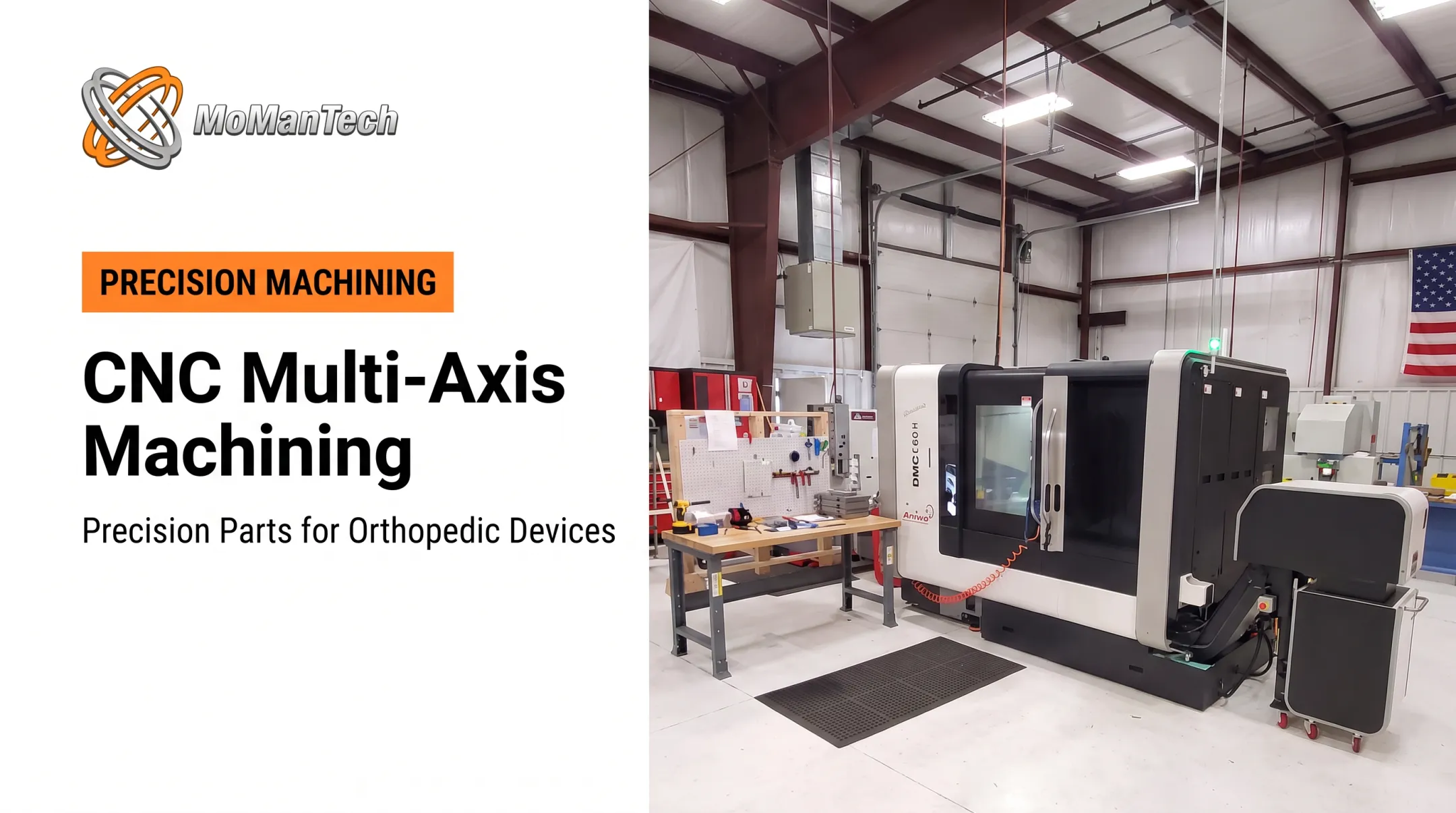
Four-axis machining adds a rotary axis to conventional X/Y/Z movement, allowing access to more faces without repositioning the part. Five-axis configurations can reach additional orientations and often eliminate multiple setups entirely.
Match axis count to the part's geometry. Confirm the configuration against the actual project rather than assuming more axes always improve the process.
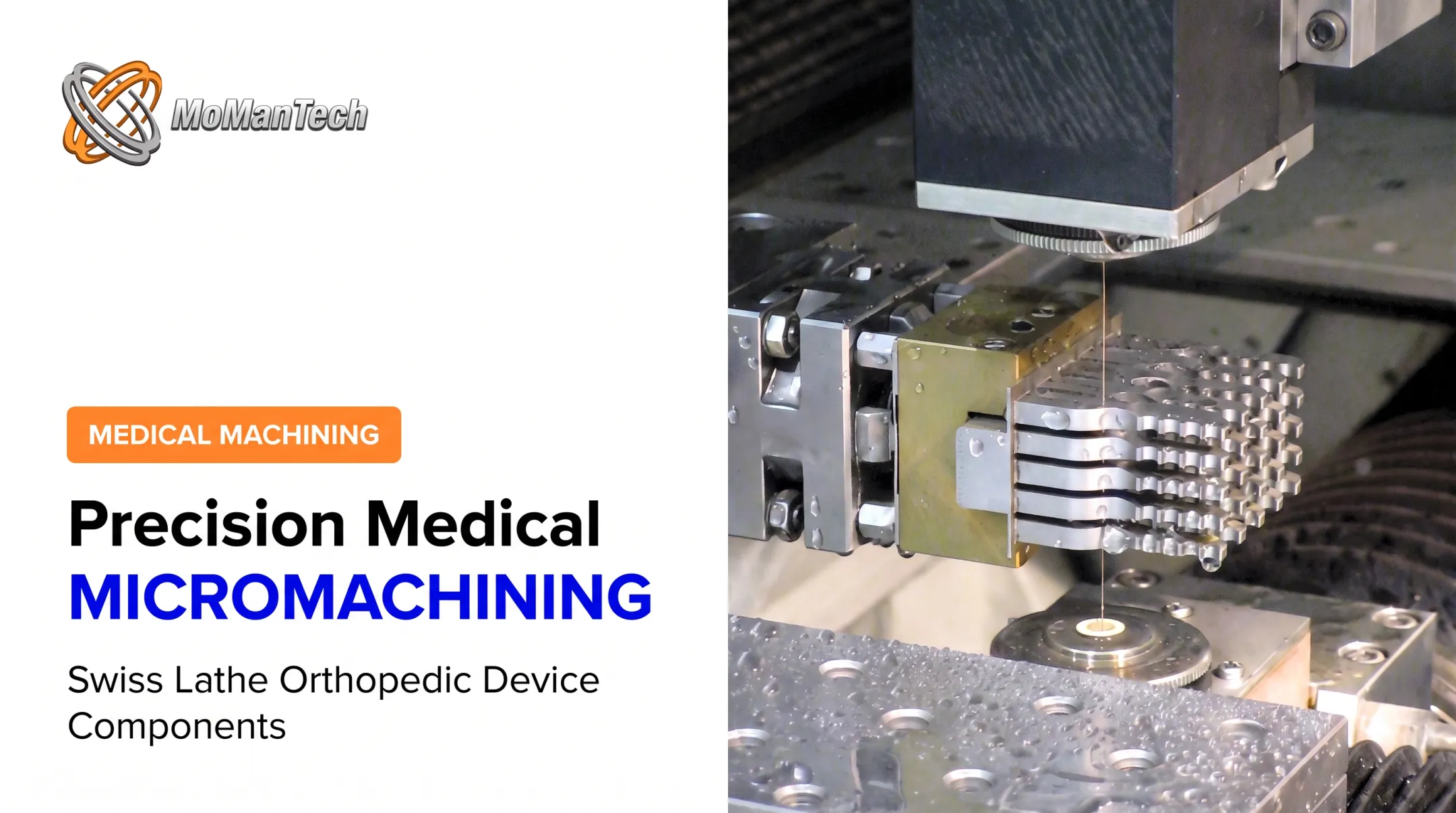
MoManTech runs two 6-axis Mazak Integrex I-150 machines and a 9-axis Quicktech S42ATM, plus multi-axis Swiss lathes for small, complex components.
Inspection Built Into Every Step
Those setups only hold if inspection catches variation early. Dimensional checks and visual review run in-process and at final inspection. Teams document results and route nonconforming parts under a defined procedure.
MoManTech's inspection equipment includes an OGP Flash 302 Vision machine for CMM and laser measurement, plus a 14-inch Mitutoyo PHA 14 with digital readout.
Engineering feedback, paired with controlled design changes, helps teams move from prototype to production without losing revision history or traceability.

Quality, Documentation, and Compliance Considerations
ISO 13485:2016 establishes a quality-management-system framework for organizations involved in medical-device design, production, and related services. That certification addresses an organization's quality processes, not FDA clearance or approval of a specific finished device.
What Records Should You Expect?
OEMs typically request several categories of documentation from a machining supplier:
- Material certifications and certificates of conformance
- First-article inspection reports
- Final inspection reports and dimensional data
- Lot or batch traceability records
- Nonconformance records and corrective actions
- Process or engineering change documentation
A supplier should follow the customer's controlled drawings, specifications, approved materials, and quality clauses, not a generic "medical-grade" claim that doesn't map to the actual drawing requirements.
FDA's component rules work differently. The agency's Quality Management System Regulation applies directly to finished-device manufacturers, including applicable contract-manufacturing activities. It does not automatically apply to a firm that machines only components or parts.
FDA still encourages those suppliers to consider its provisions, and customer quality agreements can require comparable controls, as outlined in FDA's final QMSR rule.
Before placing an order, lock down these points with your supplier:
- Who owns and retains quality records
- Acceptance criteria for each part
- How deviations get approved
- How corrective actions get communicated
MoManTech's quality system is built around controlled processes, trained personnel, and comprehensive inspection. No component leaves the facility without full inspection against its documented requirements.
Production Planning: From Prototype to Repeat Orders
CNC machining works well for pre-revenue startups and small-to-mid-size OEMs because it doesn't require dedicated tooling before volume justifies the investment. A prototype order, a first article, and a repeat production run each carry different priorities:
- Prototype — speed and design learning come first; tight tolerances matter less than fast iteration.
- First article — validation and full documentation take priority, confirming the process before scaling.
- Repeat production — capacity, consistency, and cost control become the focus.
Several factors shape a custom machining quote:
- Material cost and part complexity
- Programming time and number of setups
- Inspection requirements and finishing operations
- Packaging and lead time
Quantity alone doesn't determine cost. A geometrically complex part in small quantities can cost more per unit than a simpler part at higher volume.
Automation Changes the Capacity Equation
Automated loading and unloading, sometimes called lights-out production, can improve throughput on suitable repeat work. At MoManTech, an automated system (nicknamed BOB) handles repetitive loading and unloading on high-volume mill work. That frees skilled machinists for more complex setups while supporting overnight production.
Automation still requires process controls and inspection. It changes who or what performs repetitive tasks, not whether a part gets checked.
MoManTech's production range spans prototype quantities of 1–10 units through runs of 100 or more, scaled to part requirements and quotation review. Early communication about forecasted demand, anticipated engineering changes, annual volumes, and delivery cadence helps that relationship scale without last-minute surprises.

How to Choose a Precision Medical CNC Machining Partner
Choosing a machining partner for medical components takes more than comparing quotes. You need proof the shop can meet regulated-device expectations.
A practical evaluation checklist should cover:
- Direct experience with medical-device components, not just general machining
- ISO 13485:2016 certification or demonstrated quality-system alignment
- Willingness to collaborate on engineering and design-for-manufacturability feedback
- Material control, traceability, and certification practices
- Inspection capability and documented results
- Capacity to support both prototypes and ongoing production
- Clear, responsive communication throughout the relationship
Questions Worth Asking During Supplier Qualification
- Which materials and component types do you routinely machine?
- How are drawing revisions controlled and communicated?
- What inspection records accompany a shipment?
- How are nonconformances identified, documented, and resolved?
- How do you support first articles and engineering changes?
Ask for evidence that matches your project: sample inspection documentation, quality-system information, or references that can be shared without breaching confidentiality. A supplier confident in its process should have no trouble producing this.
MoManTech is a US-based, ISO 13485:2016-certified contract manufacturer focused exclusively on orthopedic components for spine, trauma, large-joint, and foot-and-ankle applications.
The team brings design-for-manufacturability expertise, comprehensive inspection, and documented quality control to every job. Automated production support and more than 70 years of combined hands-on leadership experience in orthopedic manufacturing stand behind that process.
If you're an OEM evaluating a machining partner, send over your drawings, material requirements, quantities, and inspection expectations. MoManTech can walk through what's achievable and quote accordingly.
Frequently Asked Questions
What is CNC in the medical field?
CNC stands for computer numerical control. In medical manufacturing, CNC machining produces precise implants, instruments, and orthopedic components from digital designs under controlled specifications.
What are precision machined components?
These are parts manufactured to specified dimensional, geometric, surface, and material requirements. Repeatability and inspection levels should match the component's intended function.
What is machining in manufacturing?
Machining is a subtractive process that removes material from a workpiece using cutting tools, shaping it to a required geometry, feature set, and surface finish.
What are some examples of medical device manufacturing?
Common examples include CNC production of spinal components, trauma hardware, joint components, foot-and-ankle parts, orthopedic instruments, and precision fixtures. Requirements vary by device and application.
How much does custom CNC machining cost?
Cost depends on material, geometry, tolerances, quantity, programming and setup time, inspection, finishing, and lead time. The most accurate answer comes from requesting a quote based on current drawings and specifications.
What is 4-axis milling?
Four-axis milling adds rotary movement to the standard three linear axes, allowing access to multiple sides or radial features with fewer repositioning steps when the part geometry calls for it.