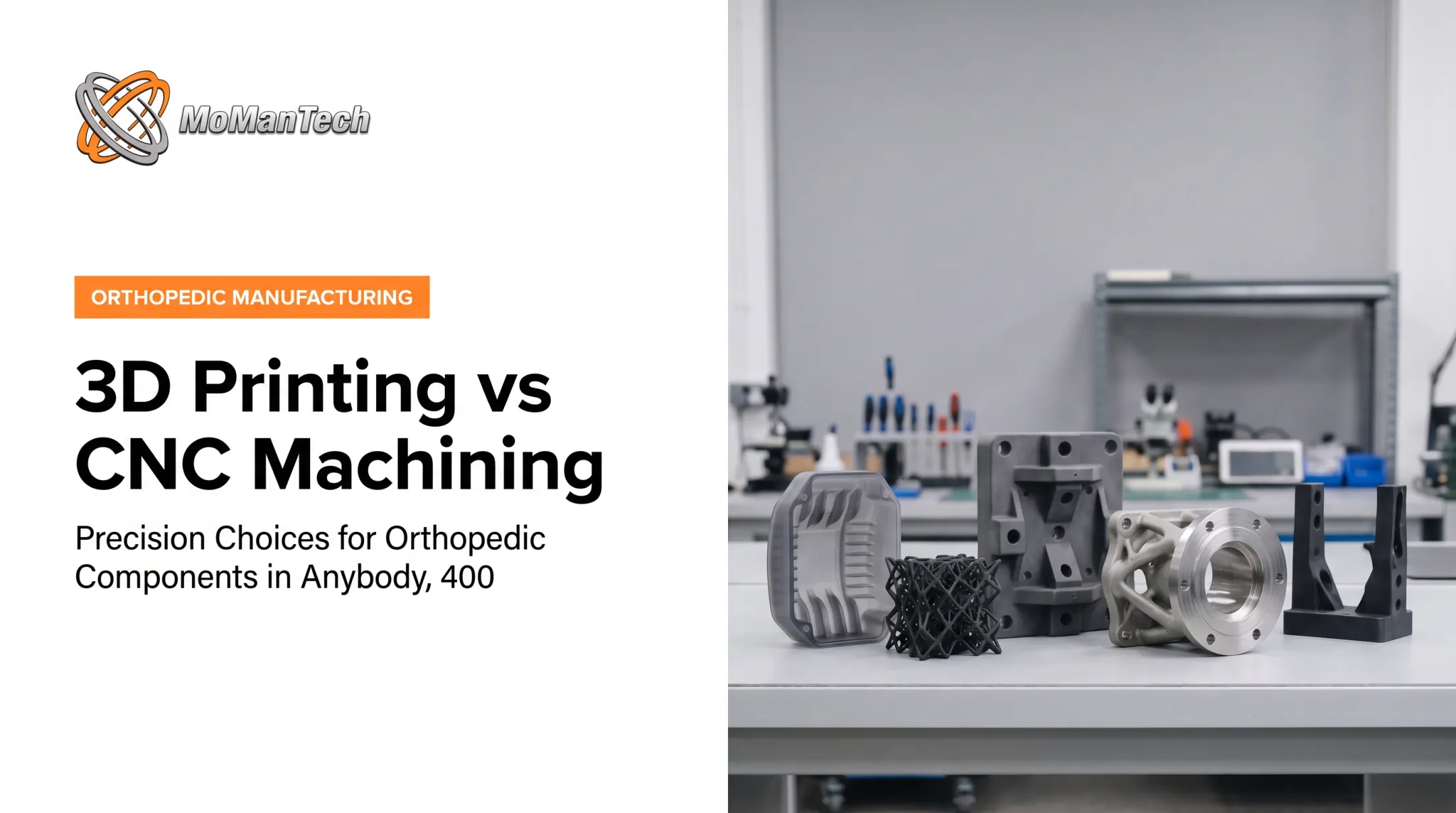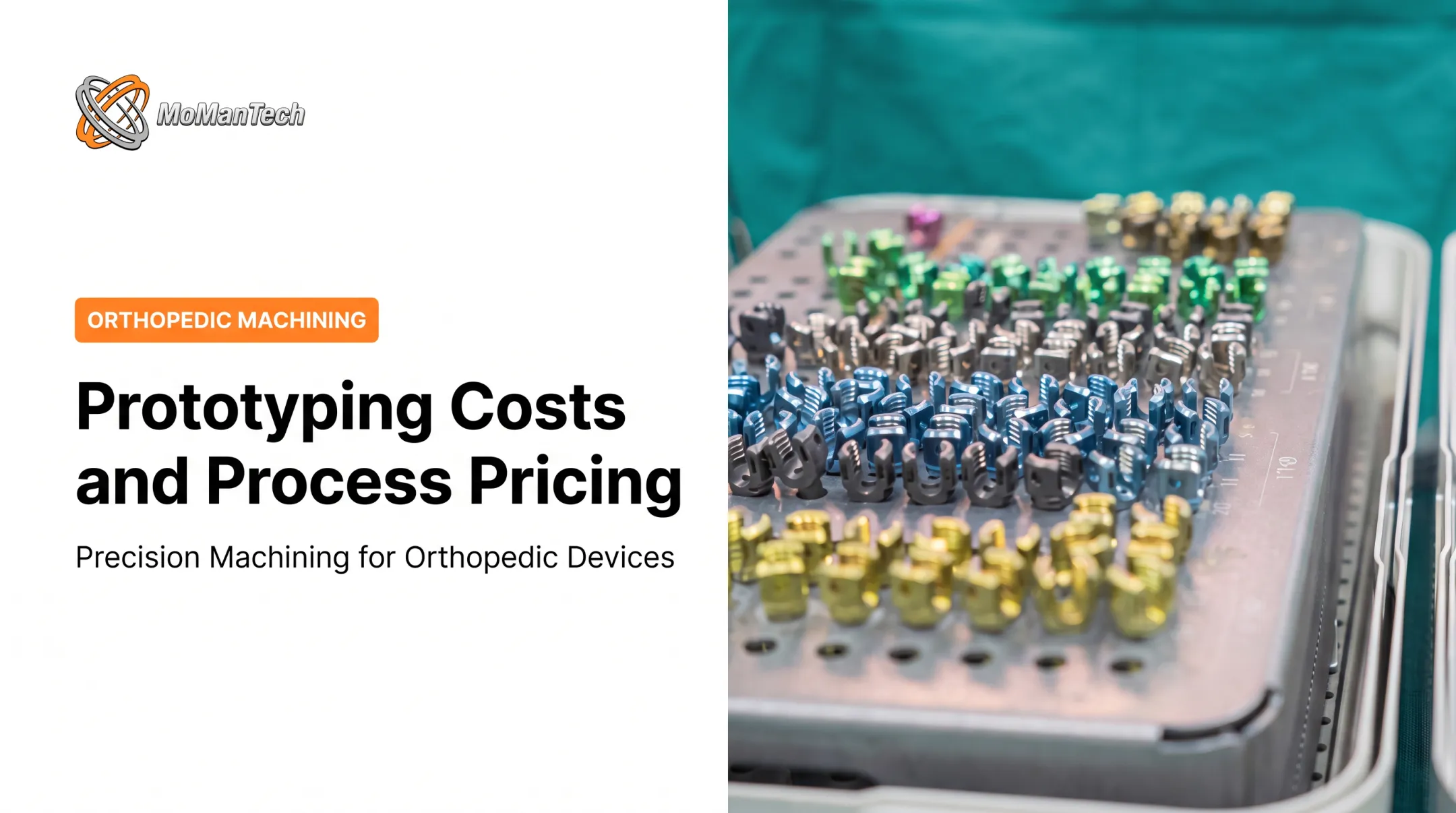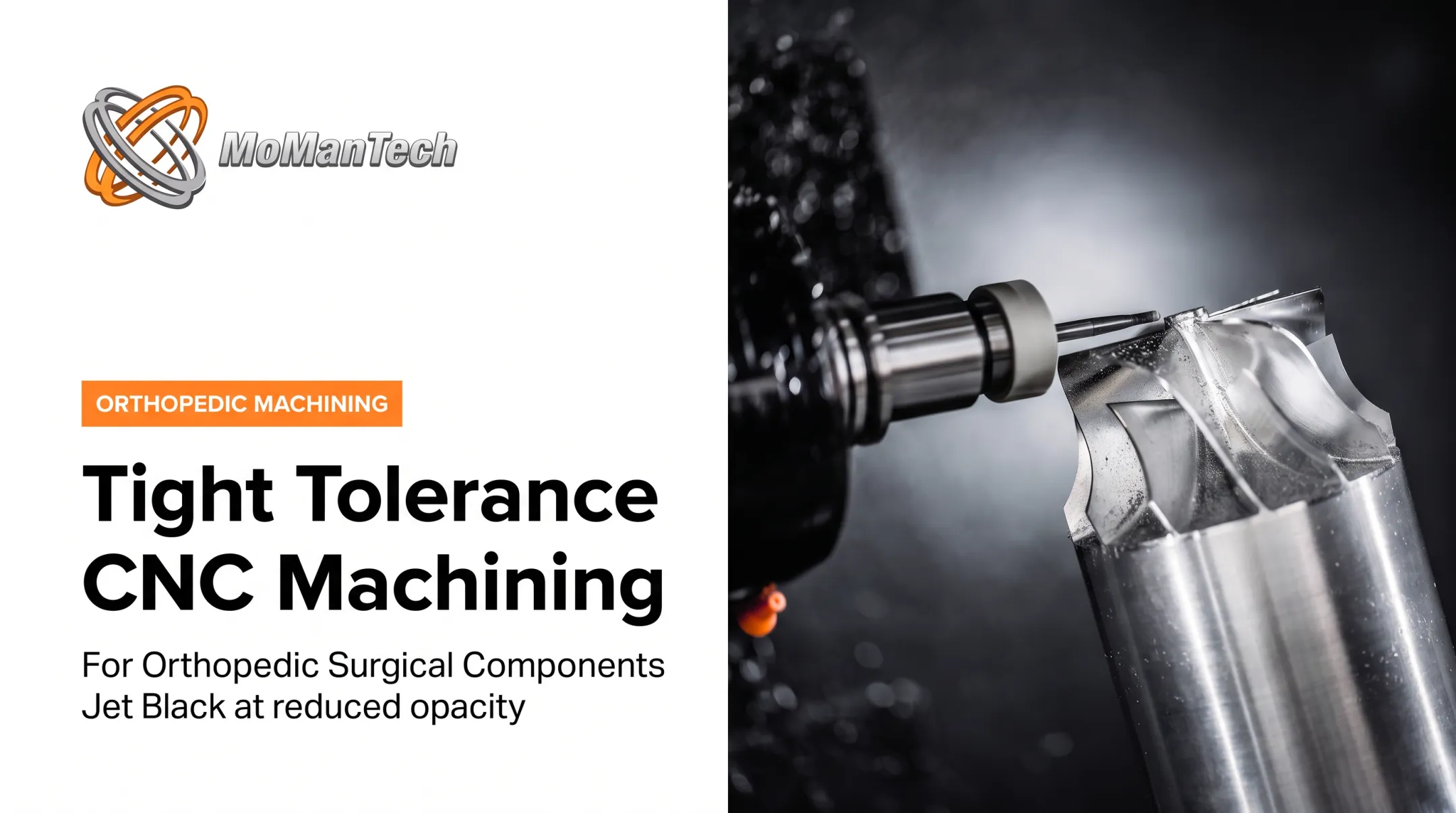

For US manufacturers and orthopedic device OEMs, choosing the right process is a critical decision. It directly impacts material waste, dimensional accuracy, surface finish, lead times, and the total cost of production. The choice determines how smoothly you can move from a single prototype to repeatable, documented manufacturing. This article compares both methods head-to-head, providing clear, situation-based guidance to help you select the best process for your specific application.
Key Takeaways
- CNC Machining: Excels at creating precision parts with tight tolerances, smooth surfaces, and high repeatability from a wide range of engineering-grade materials.
- Additive Manufacturing (AM): Offers significant advantages for parts with complex internal geometries, custom features, and for rapid design iteration during prototyping.
- Total Cost Analysis: Look beyond machine time. Factor in programming, setup, support structures, post-processing, inspection, and material scrap to understand the true cost.
- Orthopedic Components: For regulated parts, your choice must be based on process capability, material requirements, quality documentation, and production repeatability.
CNC Machining vs. Additive Manufacturing: A Quick Comparison
While both methods produce parts from a 3D CAD model, their fundamental differences create distinct advantages and disadvantages depending on the project's requirements.
Manufacturing Approach
- CNC Machining: This is a subtractive process. Computer-controlled cutting tools (like mills, lathes, or multi-axis machines) remove material from a solid workpiece of metal or plastic, such as bar stock or billet, until only the final part remains.
- Additive Manufacturing: This is an additive process. Also known as 3D printing, it builds parts by depositing, fusing, or curing material in successive layers. Each layer is a thin cross-section of the final object.
Material Usage and Waste
CNC machining inherently generates waste in the form of chips as material is cut away. The amount of scrap depends on the part's geometry versus the starting stock size.
For complex parts machined from large blocks, the buy-to-fly ratio (the weight of the raw material purchased versus the weight of the final part) can be significant. A historical aerospace example showed that producing 5 tons of finished titanium parts could require 50 tons of raw material.
Additive manufacturing often reduces material waste by building parts to a "near-net shape," using only the material needed for the part and its temporary support structures. It is not waste-free, though. You must account for unused powder in powder bed systems (much of which can be recycled), failed prints, and material removed during post-processing.
Precision and Surface Finish
CNC machining typically delivers tighter dimensional control and smoother surface finishes straight off the machine. Tolerances of ±0.005" are common, and with specialized processes, even tighter specs are achievable. For example, a polished femoral knee component can be machined to a profile tolerance of ±0.0005".
AM accuracy and surface finish vary widely depending on the technology (such as metal powder bed fusion vs. polymer extrusion), material, and build parameters like layer height. A metal part made with laser powder bed fusion might achieve an accuracy of ±50 µm, according to an EOS Ti64 datasheet.
The layered nature of the process often results in a rougher "as-built" surface that may require secondary CNC machining or polishing to meet specifications for critical mating surfaces or threads.

Production Volume and Scalability
CNC machining is often more economical and repeatable as production volume increases. Once the programming and setup are complete, machines can run parts with high speed and consistency, sometimes even unattended in a "lights-out" manufacturing environment. This makes it ideal for established designs in low- to high-volume production.
Additive manufacturing excels at producing prototypes, custom one-offs, and low-volume batches without expensive tooling or fixtures. Scalability can still be a challenge: build times can be long, and part size is limited by the machine's build envelope. While some facilities produce tens of thousands of AM parts, those runs are often highly specialized, complex components where CNC is not a viable alternative.
Geometry and Design Freedom
Additive manufacturing stands out for design freedom. AM can create parts with intricate internal channels, complex lattice structures, and organic shapes that are impossible to produce with traditional machining due to tool access limitations. Engineers can consolidate multiple components into a single, lighter, and stronger part.
CNC machining is constrained by the physics of cutting. The cutting tool must be able to reach every feature, which limits internal geometries, deep cavities, and sharp internal corners. Design for manufacturability (DFM) for CNC involves planning for tool access, workholding, and minimizing the number of setups required.
What is CNC Machining?
CNC (Computer Numerical Control) machining is a subtractive manufacturing process that uses programmed computer instructions to control high-precision machinery. Mills, lathes, Swiss-type machines, and multi-axis equipment precisely cut and shape a solid workpiece to match a digital design.
The typical workflow involves several key steps:
- Design Review & DFM: An expert reviews the CAD model to ensure it can be manufactured efficiently.
- Programming: A CAM programmer creates the toolpaths and G-code that will direct the machine.
- Setup: A skilled machinist secures the workpiece and loads the correct cutting tools.
- Machining: The machine automatically executes the program, performing roughing and finishing operations.
- Inspection: The finished part is measured to ensure all dimensions are within the specified tolerances.
- Documentation: Quality reports are generated to provide full traceability.
For orthopedic implants and instruments, CNC machining is often the preferred method. Its ability to produce parts with repeatable dimensions, predictable surface finishes, and documented quality is essential for regulated medical devices. It also works with a broad range of engineering-grade metals and polymers with well-understood mechanical properties.

Use Cases of CNC Machining
CNC is versatile enough for every stage of the product lifecycle, from single prototypes and first articles to low-volume and full-scale production. It is the go-to process when requirements include:
- Tight Tolerances: For mating components, bearing surfaces, and precise interfaces.
- High-Strength Materials: Machining titanium, stainless steel, and other medical-grade alloys.
- Smooth Surfaces: Achieving specific Ra values needed for surgical instruments or implant components.
- Validated Production: When a process must be locked down and repeated identically across thousands of parts.
In the orthopedic space, CNC is used to manufacture everything from spinal components, trauma plates, and large-bone implants to complex surgical instruments.
Process refinements still matter at scale. By refining toolpaths for surgical instrument production, one manufacturer achieved a 16% average cycle-time reduction, adding over 1,800 hours of machining capacity annually, according to a Vericut Force user story.
What is Additive Manufacturing?
Additive manufacturing (AM) is a family of processes that builds three-dimensional objects from a CAD file, adding material one layer at a time. While "3D printing" is often used as a catch-all term, AM is formally broken down into seven distinct process categories by ISO/ASTM:
- Binder Jetting (BJT)
- Directed Energy Deposition (DED)
- Material Extrusion (MEX)
- Material Jetting (MJT)
- Powder Bed Fusion (PBF)
- Sheet Lamination (SHL)
- Vat Photopolymerization (VPP)
Each category uses different machines and materials, resulting in parts with unique properties. The core benefits of AM include tooling-free production, rapid design changes, part consolidation, and the ability to create geometries that are simply impossible to machine.
The AM workflow also extends beyond just hitting "print." It requires careful design preparation, build orientation planning, generating support structures, post-processing (like heat treatment or support removal), and thorough inspection to check for issues like porosity or dimensional inaccuracies.

Use Cases of Additive Manufacturing
AM is a practical tool in product development and manufacturing. Its primary applications include:
- Quickly creates physical models for fit, form, and function testing
- Prints jigs, fixtures, and workholding devices on demand
- Manufactures lightweight components with internal lattices or consolidated assemblies
- Builds custom surgical guides or implants from patient anatomy
AM is particularly attractive for designs with frequent revisions, as a new part can be printed overnight without waiting for new tooling. In the medical field, it has enabled spinal implants with porous structures that encourage bone integration.
One project, detailed in a 3D Systems case study, brought a novel titanium spinal implant to market in under six months and has since produced over 30,000 implants, showing AM's viability for serial production in a regulated environment.
AM and CNC are not always mutually exclusive. Many AM-produced parts still need final CNC machining to hit tight tolerances on critical features like threads, holes, or mating surfaces.
CNC Machining vs. Additive Manufacturing: What is Better?
The best process is the one that best satisfies your part's functional, regulatory, quality, and economic requirements. Match the process to the job rather than defaulting to the newest technology.
When to Choose CNC Machining
Choose CNC machining when your part requires:
- Tight dimensional tolerances (less than ±0.005").
- Superior surface finish without secondary processing.
- A broad selection of engineering materials with known properties.
- High repeatability across production volumes.
- Established and efficient inspection methods
When to Choose Additive Manufacturing
Choose additive manufacturing when your design involves:
- Complex internal geometries or consolidated assemblies.
- Frequent design changes or a need for rapid iteration.
- Extensive customization or one-off parts.
- Low-volume production where CNC setup costs would be too high.
A Hybrid Approach
Often, the optimal solution involves using both technologies. For instance, you could use AM to build a near-net shape of a complex part and then use CNC machining to finish the critical surfaces. At MoManTech, we use 3D printing for rapid prototyping and custom fixturing alongside precision CNC machining, so each process handles what it does best.
Choosing the right manufacturing partner is as important as choosing the right process. For orthopedic OEMs developing components for spine, trauma, or extremities, a partner with deep expertise in both CNC and AM makes process selection practical, not theoretical.
MoManTech provides design-for-manufacturability (DFM) consultation to help you optimize your design for production. As an ISO 13485:2016 certified manufacturer, we maintain controlled processes and comprehensive inspection systems that deliver documented quality from a single prototype through full production runs.
Real-World Examples
Looking at specific cases helps clarify the decision-making process.
Complex Geometry: Spinal Lattice Implants
A project to develop cervical spine implants with complex lattice structures, designed to mimic bone and encourage integration, shows what AM can achieve. Using conventional CNC machining to create these intricate internal geometries would be impossible.
By using additive manufacturing, designers were able to create the complex part in Grade 23 Titanium. A Renishaw case study on the project notes that this approach reduced "the amount of post-processing required on key features by a factor of ten." AM made a design feasible that conventional machining could not produce.
Regulated Production: Repeatable Implant Manufacturing
The NovaSpine case mentioned earlier demonstrates AM's capability in a validated, repeatable production environment. The spinal implant design included integrated locking springs and a threaded interface, features that demand precision.
By using a validated metal AM process, the company was able to move from concept to regulatory-approved device in under six months and scale production to over 30,000 units. This case shows that with the right controls, material certification, and inspection plans, AM is a viable option for serial production of regulated medical devices.
In both examples, the process was chosen because it directly solved the primary manufacturing challenge, whether geometric complexity or the need for a validated, scalable process for a novel design.

If you're considering CNC machining or additive manufacturing for your orthopedic prototypes, first articles, or repeat production runs, the team at MoManTech can help. We can provide a design-for-manufacturability review to ensure your component is optimized for quality, efficiency, and value.
Conclusion
The debate between CNC machining and additive manufacturing is not about which process wins every job. CNC machining still leads on precision, material versatility, and repeatable production. Additive manufacturing enables complex geometries and customization, especially for prototypes and low-volume parts.
The right choice comes from a full review of your project needs. Weigh the complete manufacturing workflow: design requirements, material properties, tolerances, post-processing, inspection, and total cost. Match each process to those constraints so you cut time to market without sacrificing quality or reliability.
Frequently Asked Questions
What are the key differences between CNC machining and additive manufacturing?
CNC machining is a subtractive process that cuts material from a solid block, while additive manufacturing is a layer-by-layer process that builds a part up. This leads to major differences in material options, geometric freedom, surface finish, and cost at different production volumes.
Will CNC machining be taken over by AI?
No. AI augments CNC machining by optimizing toolpaths, assisting with programming, and enabling predictive maintenance. Per Siemens' Limitless Labs, it supports human experts who keep control of manufacturing decisions and quality.
What are the seven types of additive manufacturing?
The seven official process categories defined by ISO/ASTM are Binder Jetting (BJT), Directed Energy Deposition (DED), Material Extrusion (MEX), Material Jetting (MJT), Powder Bed Fusion (PBF), Sheet Lamination (SHL), and Vat Photopolymerization (VPP). Each uses different technologies and materials.
Why is 3D printing called additive printing?
It's called "additive" because the process creates an object by adding material in successive layers. This is in direct contrast to "subtractive" processes like CNC machining, which start with a larger piece of material and remove it to create the final shape.