
Introduction
Titanium is a contradiction orthopedic device manufacturers live with every day. It offers exceptional strength-to-weight ratio, corrosion resistance, and biocompatibility—exactly why implants and surgical instruments rely on it. Those same properties make titanium notoriously difficult to cut with conventional tools.
Low thermal conductivity traps heat at the cutting edge. Work-hardening dulls tooling fast. Chatter and deflection creep into delicate geometries.
Wire EDM sidesteps much of this. It removes material through controlled electrical discharges instead of mechanical force, so it can cut intricate profiles, narrow slots, and complex contours that would challenge a milling cutter.
This guide covers how titanium wire EDM works, why the material demands specialized process controls, the quality risks worth watching, and how to vet a US manufacturing partner before you commit a program.
Key Takeaways
- Wire EDM fits conductive titanium parts with through-features, narrow slots, and profiles mills struggle with.
- Titanium's low thermal conductivity demands tight control of generator settings, wire choice, grounding, and flushing.
- Anti-electrolysis and spark control reduce bluing and surface instability, but never replace verified inspection.
- Vet suppliers on documentation and inspection rigor, not just machine availability.
What Is Titanium Wire EDM?
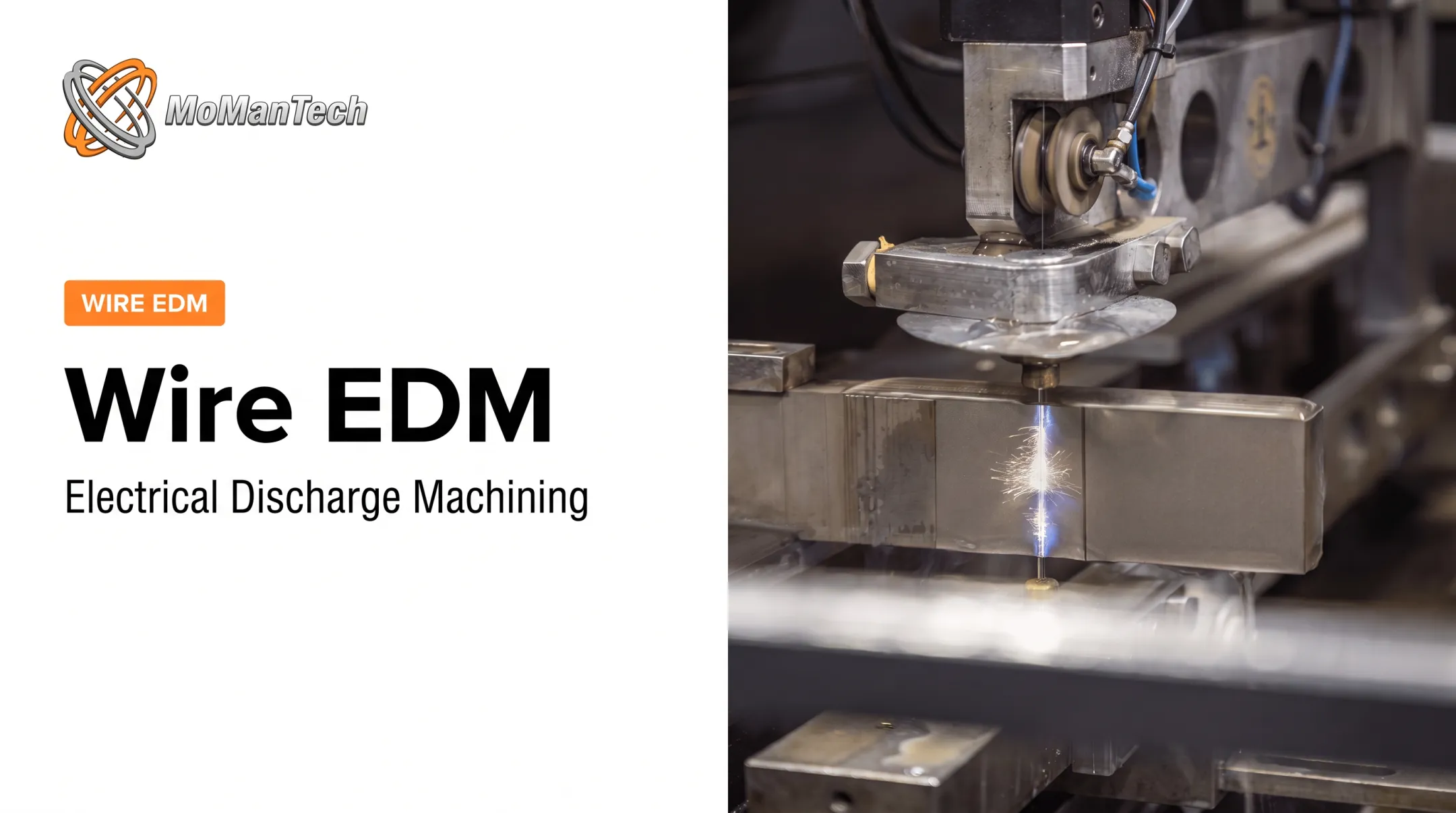
Wire electrical discharge machining is a non-contact process. A continuously fed wire electrode and a series of controlled electrical discharges erode conductive material along a CNC-programmed path. Nothing physically touches the workpiece with cutting force.
The Cutting Circuit
Four elements make the process work together:
- Wire electrode — typically brass or zinc-coated brass, continuously fed and discarded after use
- Dielectric fluid — usually deionized water, which cools the cut and flushes away debris
- Servo-controlled spark gap — maintains a precise, small separation between wire and part
- Workpiece connection — the part must be electrically connected to the machine's discharge circuit to complete each spark
Because the wire never pushes against the material, titanium wire EDM avoids much of the burr formation, tool pressure, and part deflection that plague milling on thin or delicate sections.
Wire EDM vs. Milling and Sinker EDM
Wire EDM has one geometric constraint: the wire needs a path through the material, either an edge or a pre-drilled start hole. That makes it best suited to profiles, slots, apertures, and other through-cuts rather than blind pockets.
Sinker EDM works differently. It uses a shaped electrode pressed into the material to form blind cavities and three-dimensional impressions. Wire EDM instead follows a continuous programmed contour.

A typical titanium wire EDM job moves through five stages:
- CAD model review and fixture setup
- Rough cutting along the programmed path
- One or more skim (finishing) passes
- Dimensional inspection
- Part release
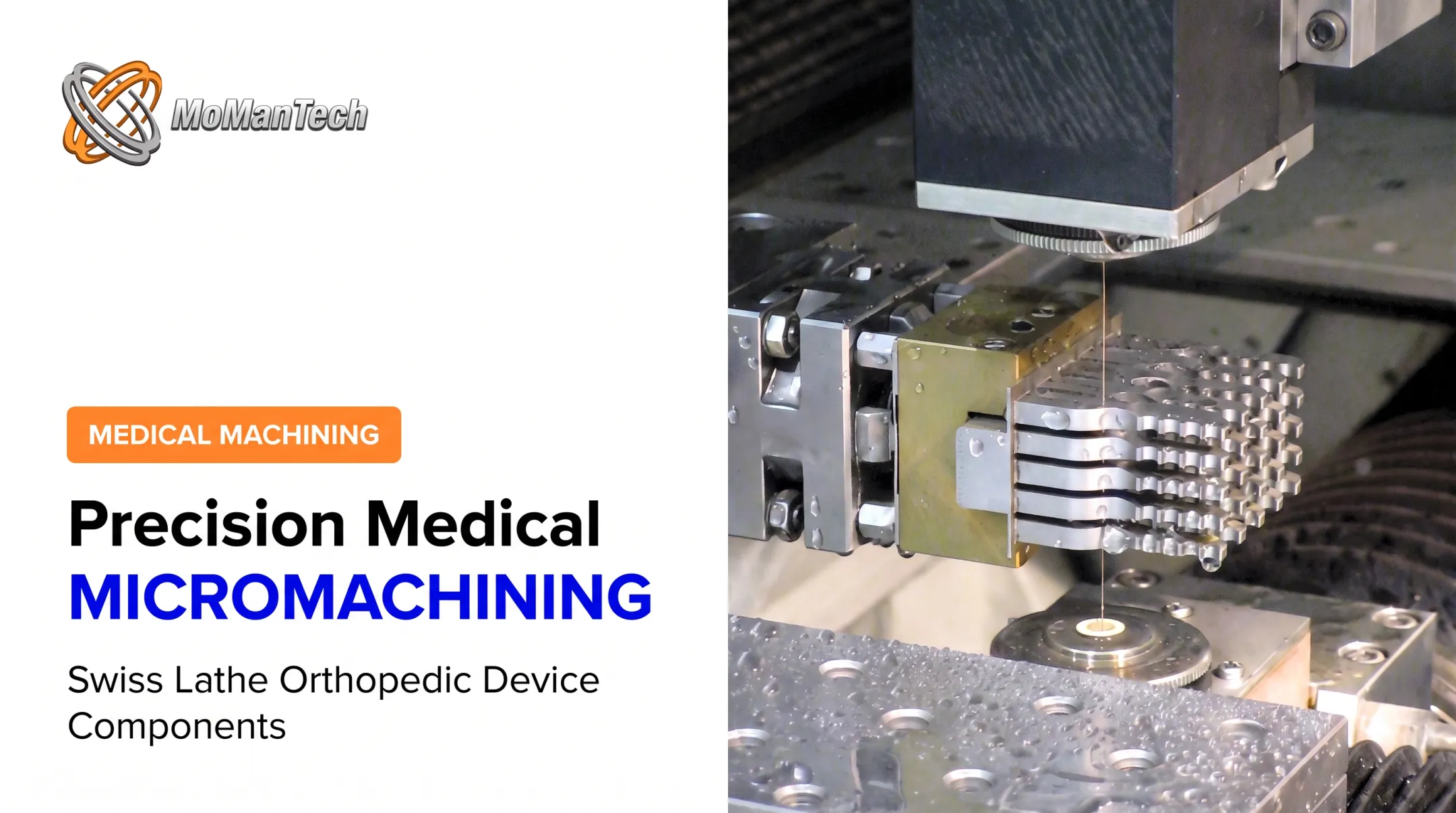
MoManTech runs this process on Chmer GX360L and Fanuc Oa wire EDM equipment for spinal, trauma, joint, and foot/ankle components where that non-contact path is a real advantage.
Why Titanium Requires Specialized Wire EDM
Titanium's machining challenges don't disappear just because wire EDM removes cutting force. They shift into thermal and electrical territory instead.
The Thermal and Electrical Challenge
Titanium alloys hold onto heat differently than steel does. A NIST comparison found Ti-6Al-4V has a thermal conductivity of roughly 7 W/(m·K), versus 50 W/(m·K) for the low-carbon steel in the same study, and the alloy retains strength even at elevated temperatures (NIST, IMECE'03). That combination concentrates heat right where you're cutting.
Titanium is conductive enough for wire EDM, and published Ti-6Al-4V work confirms it. Unstable sparking or poor grounding still shows up quickly as slower cutting, wire breakage, or inconsistent dimensions.
Thermal Damage: Recast, Bluing, and Microcracks
Research on Ti-6Al-4V wire EDM has documented surface issues tied to machine setup, parameters, and alloy condition:
- Layered recast material
- Microcracks and voids
- Transferred electrode material on cut surfaces
These are process outcomes, not fixed defect rates for every titanium job.
Bluing is separate from metallurgical damage. One documented titanium wire EDM application reported visible blue oxidation that disappeared once anti-electrolysis control was applied (Modern Machine Shop). Color alone doesn't confirm recast depth or rule out microcracks, and an uncolored cut can still hide subsurface changes a visual check won't catch.

Fine titanium particles also accumulate in the cutting gap faster than with many other metals. Dielectric cleanliness and flushing therefore matter more here than on easier-to-cut materials.
Wire choice, cutting strategy, and inspection should follow the job—not a single fixed "titanium setting":
- Material grade
- Section thickness
- Geometry
- Required surface integrity
How to Produce Quality Titanium Parts with Wire EDM
Getting consistent titanium results takes planning before the wire ever touches the part, not just good machine settings.
Pre-Cut Planning and Setup
Before cutting starts, a few questions need answers:
- Confirm the alloy and material condition - Ti-6Al-4V ELI behaves differently than other grades.
- Review the CAD profile for start-hole locations and tabs needed to hold the part during cutting.
- Assess fixturing for rigid support and reliable electrical grounding.
- Establish tolerance, finish, recast, and edge-condition requirements up front, not after the first article.
MoManTech's design-for-manufacturability consultation happens at exactly this stage, flagging difficult features before a job is quoted.
Wire, Dielectric, and Workholding Controls
Modern power supplies with anti-electrolysis or comparable spark-control technology help limit surface discoloration and manage discharge energy on titanium.
Wire selection depends on the job. Brass wire and zinc-coated brass both work in published titanium studies; the right choice hinges on machine, thickness, speed, and finish needs.
Workholding needs to prevent any part movement across long cutting cycles, and the electrical connection needs to stay solid the entire time. On the dielectric side:
- Filter and monitor fluid conductivity regularly
- Control flushing direction to clear debris from the gap
- Keep the tank clean to support stable discharges
- Watch for arc damage signs tied to poor filtration
Finishing, Inspection, and Troubleshooting
Rough cuts remove bulk material quickly. Lower-energy skim cuts then refine dimensional accuracy and surface integrity.
Inspection should match the part's risk level: CMM measurement, optical inspection, profilometry, and sometimes metallurgical cross-sectioning for critical surfaces.

MoManTech uses an OGP Flash 302 for CMM and laser measurement alongside a 14-inch Mitutoyo PHA for dimensional checks, with documented reports tied to every lot.
| Symptom | Likely Cause | Corrective Action |
|---|---|---|
| Wire breakage | Thermal overload, poor flushing, excessive tension | Reduce energy, check flushing path, adjust tension |
| Unstable sparking | Debris in gap, grounding issue | Improve filtration, verify workpiece connection |
| Rough surface / excess recast | High rough-pass energy, no skim cut | Add finishing passes, lower discharge energy |
| Taper or oversize/undersize profile | Wire tension drift, servo miscalibration | Recalibrate servo, verify wire guide wear |
| Burn marks | Localized poor flushing, dielectric contamination | Clean tank, check nozzle alignment |
Applications and Benefits of Titanium Wire EDM
Where Wire EDM Fits
Wire EDM shows up in orthopedic work wherever profiles are intricate and force on the part needs to stay low. Typical applications include:
- Implant profiles and bone plates
- Fixation components
- Surgical instruments with narrow slots or small complex features
Suitability depends on the specific geometry and finish required. Not every titanium feature is a wire EDM candidate.
Outside medical devices, aerospace and defense teams use titanium wire EDM for similar reasons: strength-to-weight ratio and corrosion resistance that justify complex contour work.
Across these uses, core benefits include:
- No mechanical cutting force on delicate geometries
- Reduced burr formation compared to milling
- Repeatable CNC paths for intricate internal contours
- Capability on geometries that are difficult to mill
Wire EDM vs. Other Processes
| Process | Best For | Trade-off |
|---|---|---|
| Wire EDM | Through-profiles, slots, thin sections, low-force cutting | Needs start holes; wire/dielectric consumption; slower on some titanium conditions |
| CNC milling | Blind pockets, accessible 3D features, higher removal rates | Tool contact brings heat, wear, deflection risk on titanium |
| Laser cutting | Thin-profile cutting | Still a thermal process; edge heat effects need evaluation |
| Sinker EDM | Blind cavities, 3D impressions | Different electrode strategy; not a through-cut method |
The right choice depends on geometry access, tolerance needs, section thickness, and volume, not a blanket rule about which process "wins."
How to Evaluate a Titanium Wire EDM Supplier
Picking a supplier comes down to more than confirming they own a wire EDM machine. Ask these questions before you commit a program:
Technical capability:
- What's their experience with your specific titanium alloy?
- What are their maximum workpiece dimensions and thickness?
- What generator and spark-control technology do they run?
- Do they offer taper or multi-axis cutting if your geometry needs it?
- How do they handle start-hole strategy on complex profiles?
Quality systems:
- Can they produce inspection records and traceability documentation?
- How do they handle nonconformance?
- Can they support prototype runs, first articles, and repeat production without starting over each time?
Design for manufacturability:
- What are their minimum feature sizes and corner radii?
- How do they flag difficult features before quoting, not after?
Capability and DFM answers only go so far without the quality system behind them. For orthopedic OEMs, quality documentation matters as much as cutting capability.
US medical-device manufacturers work under FDA's Quality Management System Regulation, which incorporates ISO 13485:2016 by reference (FDA QMSR). A supplier's own certification doesn't automatically clear your finished device, but it does signal they understand the documentation trail your quality system will expect from them.
MoManTech is an ISO 13485:2016-certified contract manufacturer working exclusively with spine, trauma, large joint, and foot/ankle device OEMs. The shop supports design-for-manufacturability review early in planning and documents inspection on every component. It scales from prototype quantities of 1-10 units to production runs of 100+.
For an initial review, have these ready:
- 2D drawing and 3D model
- Titanium grade and material certification requirements
- Target quantity
- Tolerance and finish requirements
- Inspection expectations
- Target timing
Frequently Asked Questions
What materials can an EDM cut?
EDM generally requires electrically conductive materials, including many titanium alloys, steels, carbide, and nickel alloys. Nonconductive ceramics, plastics, and most composites need a different process or a conductive treatment first.
Why is titanium widely used in medical devices?
Titanium combines a high strength-to-weight ratio, corrosion resistance, and biocompatibility, which is why it's used in implants and instruments. Those same properties, particularly low thermal conductivity, are what complicate conventional machining.
Is titanium hard to machine with CNC?
Titanium can be CNC machined successfully with the right tooling, speeds, feeds, rigidity, and cooling. Wire EDM often becomes preferable when the profile is intricate or the feature is too delicate for cutting forces.
Can wire EDM cut titanium?
Yes, wire EDM cuts conductive titanium alloys regularly. Success depends on grounding, dielectric control, wire selection, generator technology, and the right finishing passes for the required surface condition.
What are the main challenges of wire EDM for titanium?
Expect slower cutting in some conditions, spark instability from debris buildup, wire breakage risk, and recast or heat-affected layers. Parameters need validation for each specific grade and geometry, not a generic setting.
Is wire EDM better than CNC milling for titanium?
Neither process wins universally. Wire EDM tends to work better for intricate through-profiles and thin, delicate sections, while milling is often faster for accessible 3D features and higher material-removal needs.