
If you're trying to figure out whether wire EDM fits a hard, delicate, thick, or tight-tolerance component, you're not alone. Many manufacturers struggle with this exact question when a part is too hard for a standard end mill, too thin to survive clamping forces, or too geometrically complex for conventional tooling.
This article covers how wire EDM actually works, where it earns its keep, where it falls short, and how it stacks up against milling, sinker EDM, waterjet, and laser cutting. We'll also look at cost and speed considerations so you can make an informed call before committing to a process.
Key Takeaways
- Wire EDM is a CNC-controlled, non-contact process that erodes conductive material with a continuously fed wire and dielectric fluid.
- Best suited to complex profiles, small internal radii, hardened metals, and thin sections prone to deformation.
- Material, thickness, tolerance, and quantity drive cost and speed—it is not automatically the fastest or cheapest choice.
- MoManTech runs Chmer GX360L and Fanuc Oa wire EDM for orthopedic spinal, trauma, joint, and foot/ankle components under ISO 13485:2016.
What Is Wire EDM?
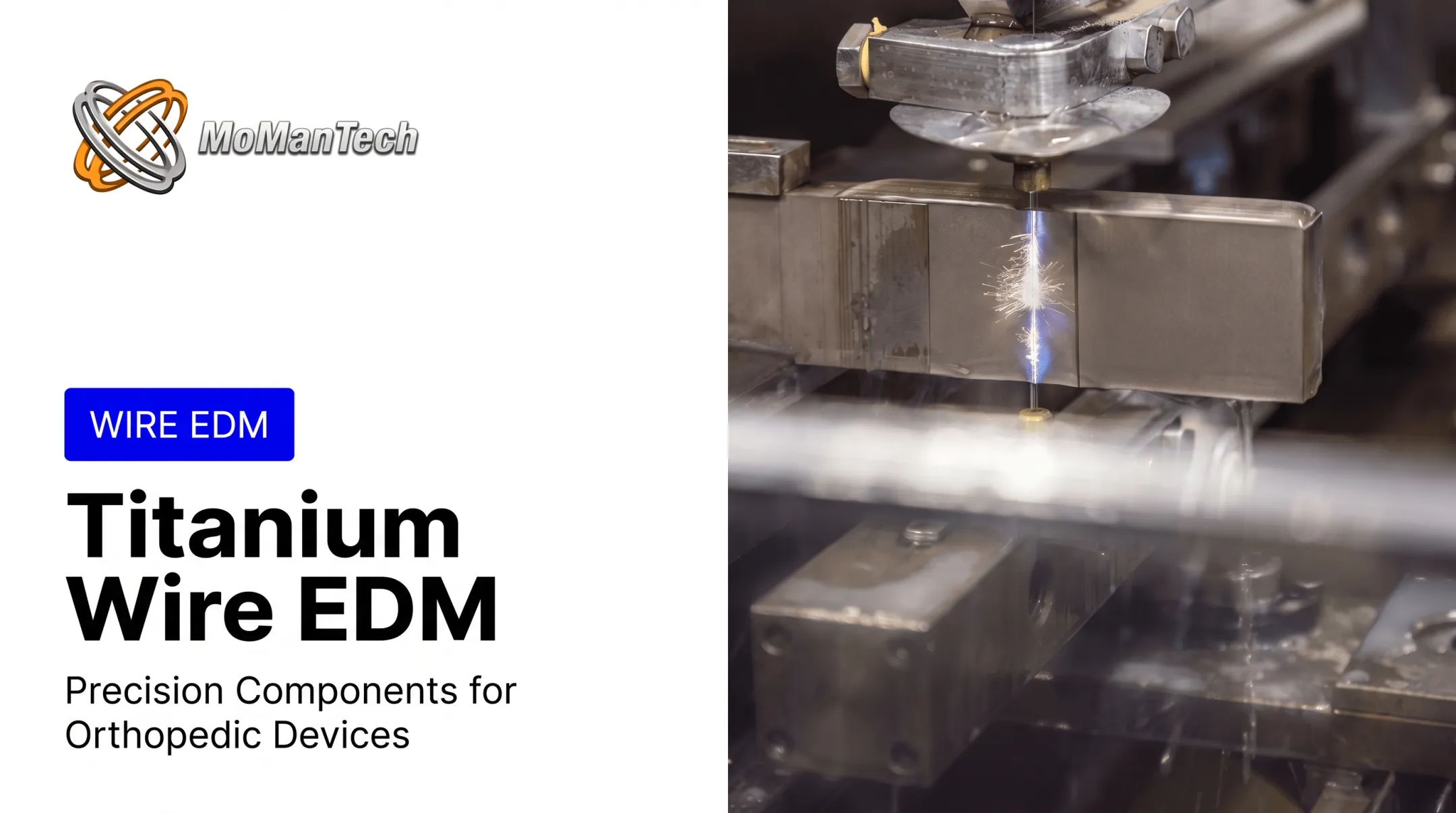
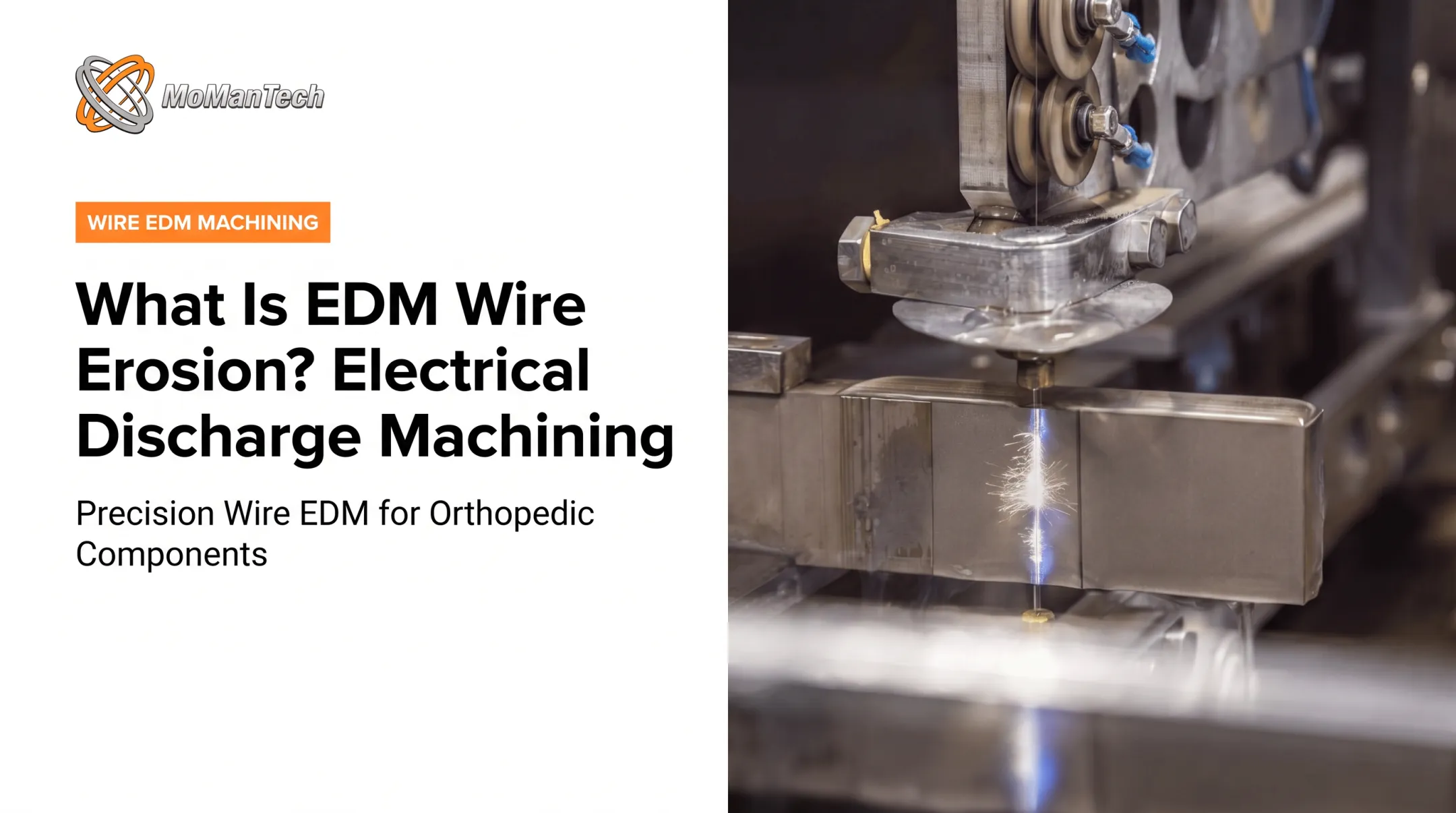
Wire electrical discharge machining - also called wire-cut EDM or just wire EDM - cuts conductive metal using electrical sparks instead of a physical blade. A thin wire electrode travels through the workpiece without ever touching it. Each spark melts or vaporizes a microscopic sliver of metal, and thousands of these discharges per second add up to a finished profile.
The Core Components
A wire EDM setup includes:
- CNC controller that drives the cutting path
- Wire spool and feed mechanism supplying fresh wire continuously
- Upper and lower wire guides that keep the wire taut and positioned
- Dielectric fluid system (typically deionized water) that insulates and flushes the cut
- Filtration system removing eroded particles
- Worktable and workholding securing the part during the cut
Materials and Part Suitability
The workpiece must conduct electricity. That's the one non-negotiable requirement. Within that constraint, shops commonly wire EDM:
- Hardened tool steel
- Stainless steel
- Titanium
- Carbide
- Aluminum alloys
Not every material cuts at the same speed or leaves the same finish. Thickness changes the equation too - a thin titanium plate behaves very differently under the wire than a thick block of hardened tool steel.
Since the wire never applies mechanical pressure, there's no tool deflection, no chatter, and no clamping-induced warpage to fight. That matters when a part is thin, fragile, or made from material too hard for a conventional cutter to bite into without rapid tool wear.
Geometric Scope and Sinker EDM
Wire EDM is built for through-cuts: profiles, slots, contours, and tapered edges, anywhere the wire can pass entirely through the stock. Blind cavities and many three-dimensional forms fall outside its reach.
For those features, sinker EDM uses a shaped electrode pressed into the material rather than a traveling wire. That makes sinker the better fit for cavity-forming work, while wire EDM owns the through-profile niche.
How Does Wire EDM Work?
Setup and Threading
Before cutting starts, the operator secures and aligns the conductive workpiece, then establishes a start point - either an open edge or a pre-drilled start hole. The wire threads between the upper and lower guides, the CNC program is loaded, and cutting parameters are set for the specific material and thickness.
The Spark-Erosion Cycle
Once cutting begins, the power supply creates a controlled voltage difference between the wire and the workpiece. The dielectric fluid in the gap breaks down locally, and a spark jumps across, melting or vaporizing a tiny amount of metal. This repeats thousands of times per second as the wire advances.
Deionized water does three jobs at once:
- Insulates the gap between discharges so sparks stay controlled
- Cools the cutting zone to prevent thermal buildup
- Flushes eroded particles into the filtration system
Because the wire wears from continuous discharges, it's fed from a spool and consumed, so it isn't reused the way a milling cutter is.
CNC Motion and Multi-Axis Control
CNC motion drives the wire along the X and Y axes. On machines that support it, independent upper and lower guide movement allows tapered cuts and profiles that differ between the top and bottom faces of the part.
That path control is what makes complex contours practical—and why cut strategy still matters after the first pass.
Finishing Passes and Precision
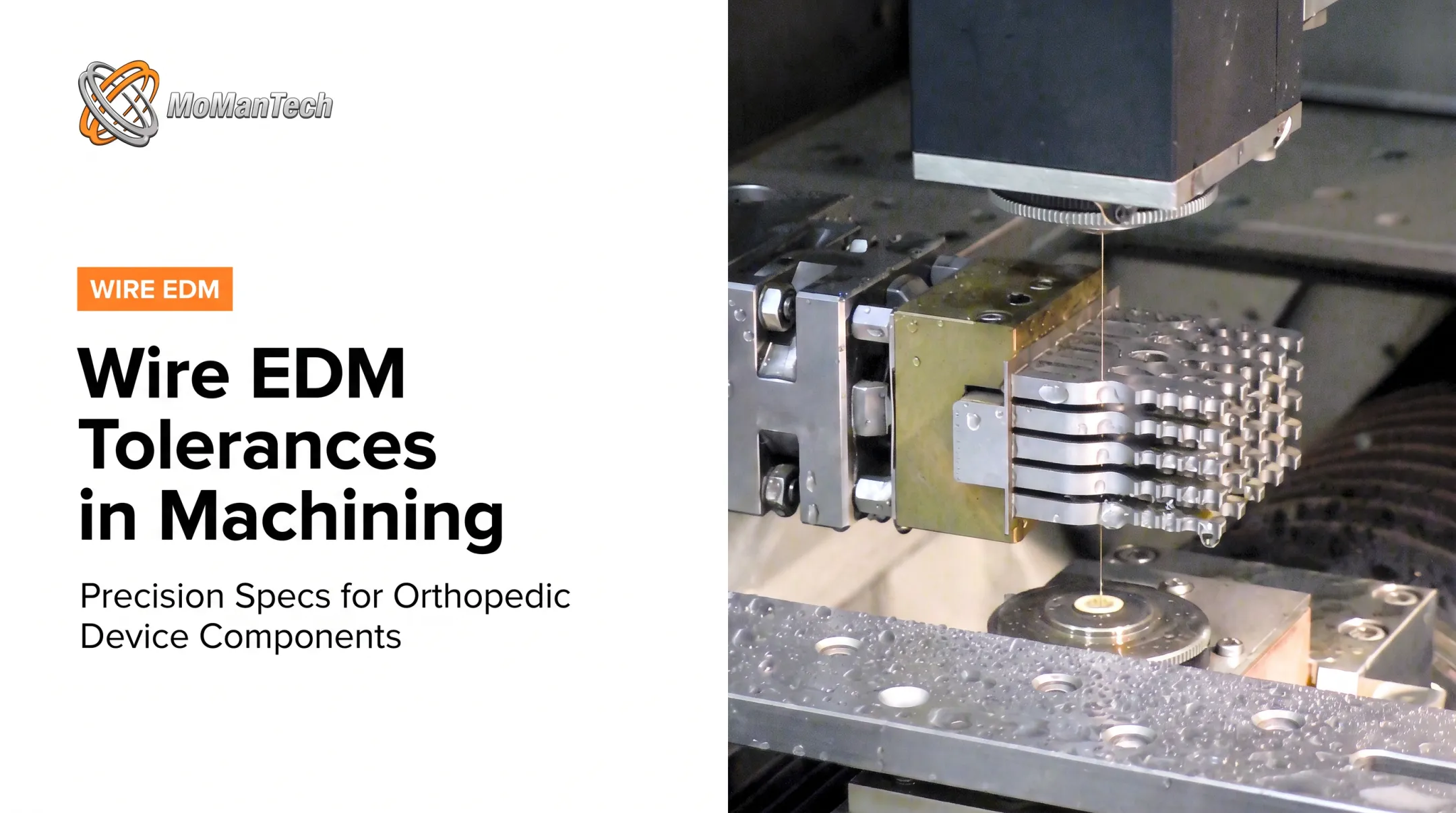
A rough cut removes the bulk of material quickly. Skim passes follow, removing very little material each time while improving dimensional accuracy and finish.

Sodick, for example, documents a sample cut in 100-mm-thick SKD11 tool steel with 0.2-mm wire that achieved ±3 micron accuracy and 0.20 micron Ra finish. Those figures belong to that specific machine, material, and wire combination—not a universal guarantee for every job.
Thermal Considerations
Wire EDM applies no cutting force, but it's still a thermal process. Localized discharge heat can leave a heat-affected zone and a thin recast layer on the cut surface.
A study on powder-metallurgy titanium found that wire EDM left a compositionally altered, fractured surface layer containing wire and dielectric byproducts. Grinding away roughly 20 microns eliminated the fractures in that experiment, but that allowance isn't a standard spec.
Medical and other critical components need surface requirements validated for the actual material, geometry, and inspection method involved.
What Is Wire EDM Used For?
Wire EDM earns its place when a job hits one of these conditions:
- Complex through-profiles, narrow slots, small internal radii, gears, keyways, punches, and die sections
- Hardened tool steels, carbide, titanium, and other difficult-to-machine conductive materials
- Thin or delicate parts prone to bending, chatter, or distortion under conventional cutting forces
- Prototype, first-article, repair, and low-to-moderate-volume work where dedicated cutting tools would add cost or lead time
Industries and Representative Parts
Typical through-cut work shows up in several sectors:
- Tool and die: stamping punches and mold inserts
- Aerospace: angled dovetails and slots inside large rings
- Electronics: IC lead-frame progressive dies, often with roughing wire as fine as 0.25 mm
- Automotive tooling: sintering punch-and-die sets in steel and carbide
Orthopedic and Medical-Device Applications
In orthopedics, wire EDM supports components like resection blocks, bone plates, and related fixtures - provided the geometry is a through-profile and the material is conductive. It may play a role in spinal, trauma, large-bone, and foot-and-ankle device development, but not every implant or instrument is a good candidate. Geometry and material still decide feasibility case by case.
MoManTech's Wire EDM Machining service runs on Chmer GX360L and Fanuc Oa equipment for highly engineered spinal, trauma, joint, and foot/ankle components. Parts are inspected under ISO 13485:2016-certified processes before they leave the facility.

Orthopedic OEMs evaluating a wire EDM partner should compare certification, design-for-manufacturability support, documented quality processes, and experience moving parts from prototype through production.
What Affects Feasibility and Quote Accuracy
- CAD geometry and feature complexity
- Material grade and condition
- Stock thickness
- Start-hole requirements
- Tolerance, surface-finish, and taper targets
- Quantity (prototype vs. production)
- Inspection documentation needed
- Post-processing or cleaning requirements
Advantages and Limitations of Wire EDM
Wire EDM earns its place on tough geometries and hard conductive metals, but it is not a universal replacement for milling or other bulk-removal methods. Use the tradeoffs below to judge fit for your part.
Advantages
- High repeatability and fine feature control when machine, program, and workholding are well controlled
- Machines hardened conductive materials without needing a cutter harder than the workpiece
- Low mechanical force, reducing deformation risk in thin or fragile features
- Narrow kerf and small internal radii, shaped partly by wire diameter and process conditions
- Reduced secondary finishing when the required edge condition can be met in-process
Limitations
- Electrically conductive workpiece required - no exceptions
- Through-wire path needed; the wire generally must pass through the part, so blind cavities aren't a standard application
- Slower material removal than bulk methods like milling, especially on thick sections or demanding finishes
- Added cost and cycle time from wire consumption, dielectric filtration, threading, and multiple finishing passes
Precision and finish figures vary widely by machine, material, thickness, and pass count, as the earlier Sodick example showed. Treat any single tolerance or Ra number as conditional, not a blanket spec for your part.
Wire EDM Compared With Other Cutting Methods
Wire EDM vs. CNC Milling
Wire EDM is the stronger fit when you need:
- Conductive, hardened materials
- Intricate through-profiles cut with low force
CNC milling generally wins on:
- Three-dimensional forms, pockets, and blind features
- Faster bulk material removal
Many components use both: wire EDM for the fine profile work, milling for everything else.
Wire EDM vs. Sinker EDM
Wire EDM creates through-cut profiles with a moving wire. Sinker EDM creates cavities and blind impressions with a shaped electrode. Electrode fabrication time, geometry, and production quantity all steer which one makes sense for a given job.
Wire EDM vs. Waterjet and Laser Cutting
Waterjet cuts a broader range of materials, including non-conductive ones, without heat input. Laser cutting moves fast on thin flat sheet but introduces thermal input of its own.
For stock under about 1 inch thick, OMAX describes abrasive waterjet as generally faster than wire EDM. That comparison doesn't specify matched materials, machines, or finish requirements, so treat it as directional rather than a fixed multiplier. Speed always comes down to material, thickness, geometry, and the quality bar you're cutting to.

Decision Checklist
| Factor | Question to Ask |
|---|---|
| Conductivity | Is the material electrically conductive? |
| Geometry | Through-profile, or does it need a blind cavity? |
| Hardness | Would conventional cutters wear quickly? |
| Thickness | Thin and delicate, or thick and bulky? |
| Tolerance | Tight enough to need skim passes? |
| Surface finish | Does the spec allow for a recast layer? |
| Quantity | Prototype run, or production volume? |
| Lead time | Can you absorb threading and setup time? |
If you're an orthopedic OEM weighing wire EDM against another process for a spinal, trauma, large-joint, or foot-and-ankle component, review geometry, material, quantity, and inspection needs first. MoManTech's team can help you lock in the right manufacturing approach before you commit.
Frequently Asked Questions
What is wire EDM?
Wire EDM is a CNC-controlled process that uses a continuously fed wire electrode and dielectric fluid to erode conductive material with electrical discharges. The wire never touches the part, so delicate or thin-walled geometries stay free of cutting force.
What is wire EDM used for?
It cuts precision through-profiles in hardened conductive materials—dies, punches, slots, and delicate parts. Orthopedic work often includes components such as resection blocks and bone plates.
What is the precision of wire EDM?
Documented examples reach the low single-digit micron range under controlled conditions. Real-world accuracy still tracks machine capability, setup, material, thickness, temperature control, wire tension, and finishing passes.
How deep can wire EDM cut?
Machine Z-axis travel sets the working envelope. Practical depth and accuracy at that limit still hinge on flushing, wire stability, material, and taper requirements.
What is the typical cutting rate of wire EDM?
Speed changes with material conductivity, thickness, wire type, electrical settings, flushing, and how many finishing passes the job needs. Treat cutting rate as job-specific, not a single catalog number.
How expensive is wire EDM?
Price reflects programming, setup, material thickness, cutting length, wire use, finishing passes, inspection, and quantity. Request a quote for your geometry and material instead of using a generic rate.