
Introduction
Low-volume manufacturing means producing a limited run of parts or products when demand, design maturity, or market size doesn't justify investing in mass-production tooling.
A startup testing a new trauma plate design needs five units, not 50,000. An established OEM bridging the gap between FDA clearance and full-scale distribution needs hundreds, not millions.
Many orthopedic device companies struggle to find manufacturing partners willing to work at this scale. Quantities are small, tolerances are tight, and documentation requirements don't shrink just because the order does.
This guide covers production methods, process selection, cost drivers, quality planning, and supplier evaluation for low-volume manufacturing, with particular attention to precision orthopedic medical-device components.
Key Takeaways
- Low-volume cutoffs depend on industry, process, and complexity; no single quantity fits every product.
- Match the process to the job: CNC, additive, molding, and casting fit different materials, geometries, and run sizes.
- Treat design-for-manufacturability and documented inspection as equal priorities to the machine on the floor.
- Pick a partner that scales from prototype to repeat production without early high-volume tooling lock-in.
What Low-Volume Manufacturing Means
There's no fixed unit count that defines "low volume." Fictiv places the general range between 10 and 10,000 units, while other industry sources describe it as anywhere from a handful of parts to tens of thousands.
What counts as high volume in consumer electronics might be a large batch in orthopedics, where clinical caution and regulatory scrutiny keep run sizes modest by design.
Prototype, Low-Volume, and High-Volume Production Compared
| Factor | Prototype | Low-Volume | High-Volume |
|---|---|---|---|
| Typical quantity | 1-10 units | Tens to low thousands | Tens of thousands+ |
| Design maturity | Early, still changing | Validated, may still evolve | Locked and released |
| Tooling investment | Minimal or none | Soft tooling or none | Hard tooling, dedicated |
| Unit economics | Highest per-unit cost | Moderate per-unit cost | Lowest per-unit cost |
| Change flexibility | Very high | High | Low, costly to modify |
Treat these ranges as illustrative, not as rigid rules. A 50-unit spinal instrument kit and a 50-unit automotive bracket face very different manufacturing constraints.
High-Mix, Low-Volume Production Is Its Own Challenge
High-mix, low-volume (HMLV) production means running many different part numbers in small batches rather than one part repeatedly. This is common in orthopedics, where a single OEM might need spinal screws, trauma plates, and instrument components machined in the same month.
HMLV creates extra demands:
- Frequent machine changeovers and setup
- More complex scheduling across part families
- Expanded documentation per part number
- Greater inventory complexity
Typical low-volume use cases include:
- Engineering validation builds
- First articles
- Limited-market product launches
- Aftermarket replacement parts
- Early production for startup OEMs still proving out a design
Why Companies Use Low-Volume Production
Committing to high-volume tooling before a design is finalized is risky. Low-volume production lets companies limit that exposure while accepting a trade-off: lower tooling investment generally means higher per-unit cost.
Supporting Design Iteration and Validation
Small production runs give engineering teams room to:
- Test form, fit, and function before committing to a final design
- Gather surgeon or customer feedback on early builds
- Complete first-article inspection ahead of full release
- Adjust tolerances or materials without scrapping an expensive mold
Bridging the Gap to Full Production
Bridge production keeps supply flowing while production tooling, regulatory submissions, supplier qualification, or demand forecasts are still in progress. It's the difference between telling a hospital system "we'll have inventory in six months" and actually having product on hand.
Reducing Inventory Risk
Low-volume runs also reduce the risk of sitting on unsold inventory, which matters for specialized or customized product lines that don't move in bulk.
That pattern matches orthopedic demand. Spinal, joint, trauma, extremity, and foot-and-ankle components often need modest quantities, tight process control, and full inspection documentation—not a 10,000-unit minimum.
The trade-offs are real:
- Higher setup cost per unit
- Dependence on skilled machinists rather than automated lines
- More complex scheduling
- Tight day-to-day communication with your supplier
A partner focused on orthopedic components, such as MoManTech, makes those trade-offs manageable.
Low-Volume Manufacturing Processes
Process selection depends on quantity, material, geometry, tolerances, finish, lead time, and expected future volume. The main options below show where each process fits.
CNC Machining
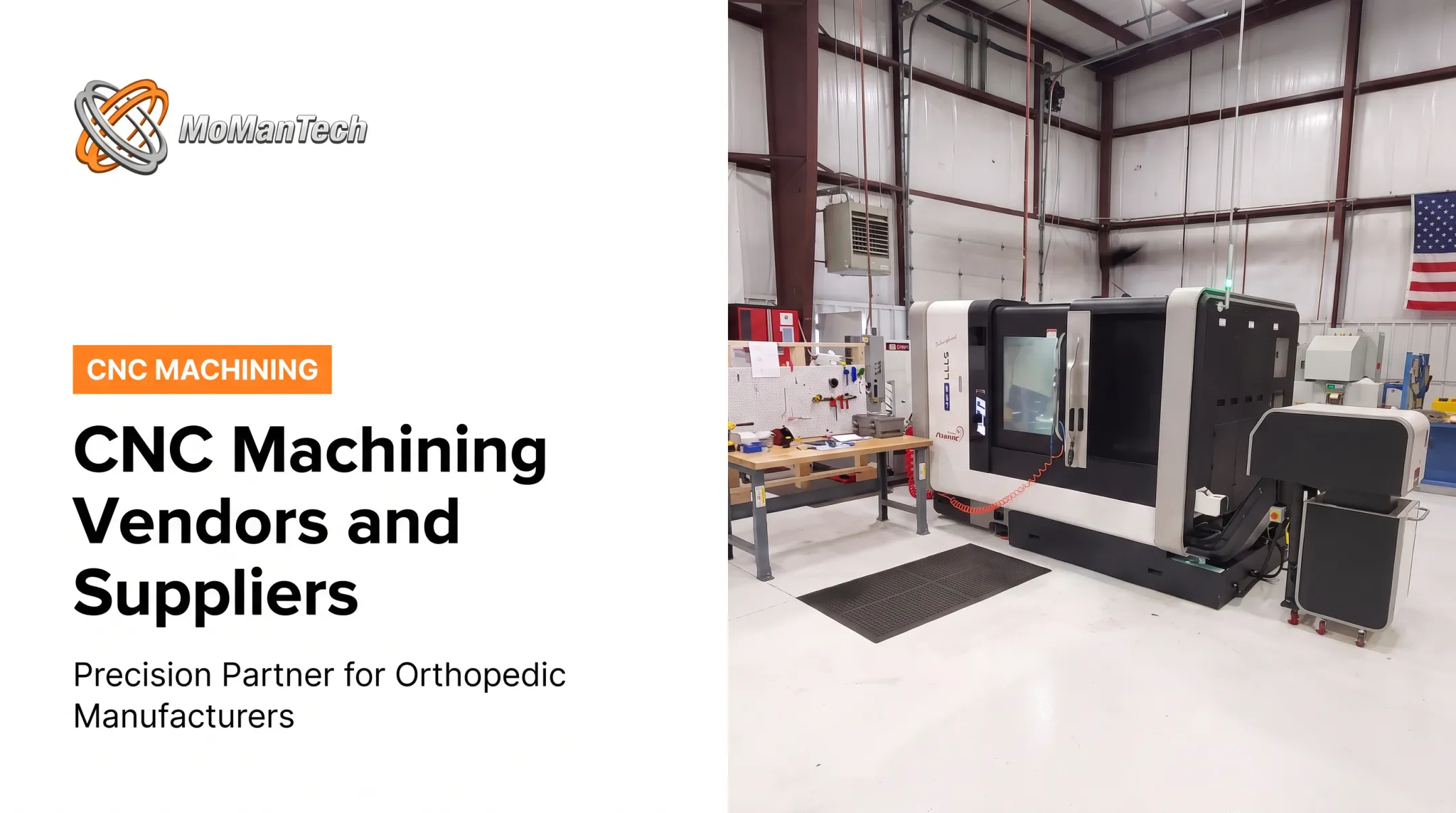
CNC milling and turning remove material from metal or plastic stock using computer-controlled equipment, producing accurate, repeatable parts without any dedicated mold or die.
Strengths:
- Works across a wide range of metals and plastics
- Handles complex geometries and tight tolerances
- Produces production-quality parts without tooling investment
- Scales from a single prototype to hundreds of units
Limitations:
- Programming and fixturing take time upfront
- Material waste from subtractive cutting
- Some geometries are difficult to access with standard tooling
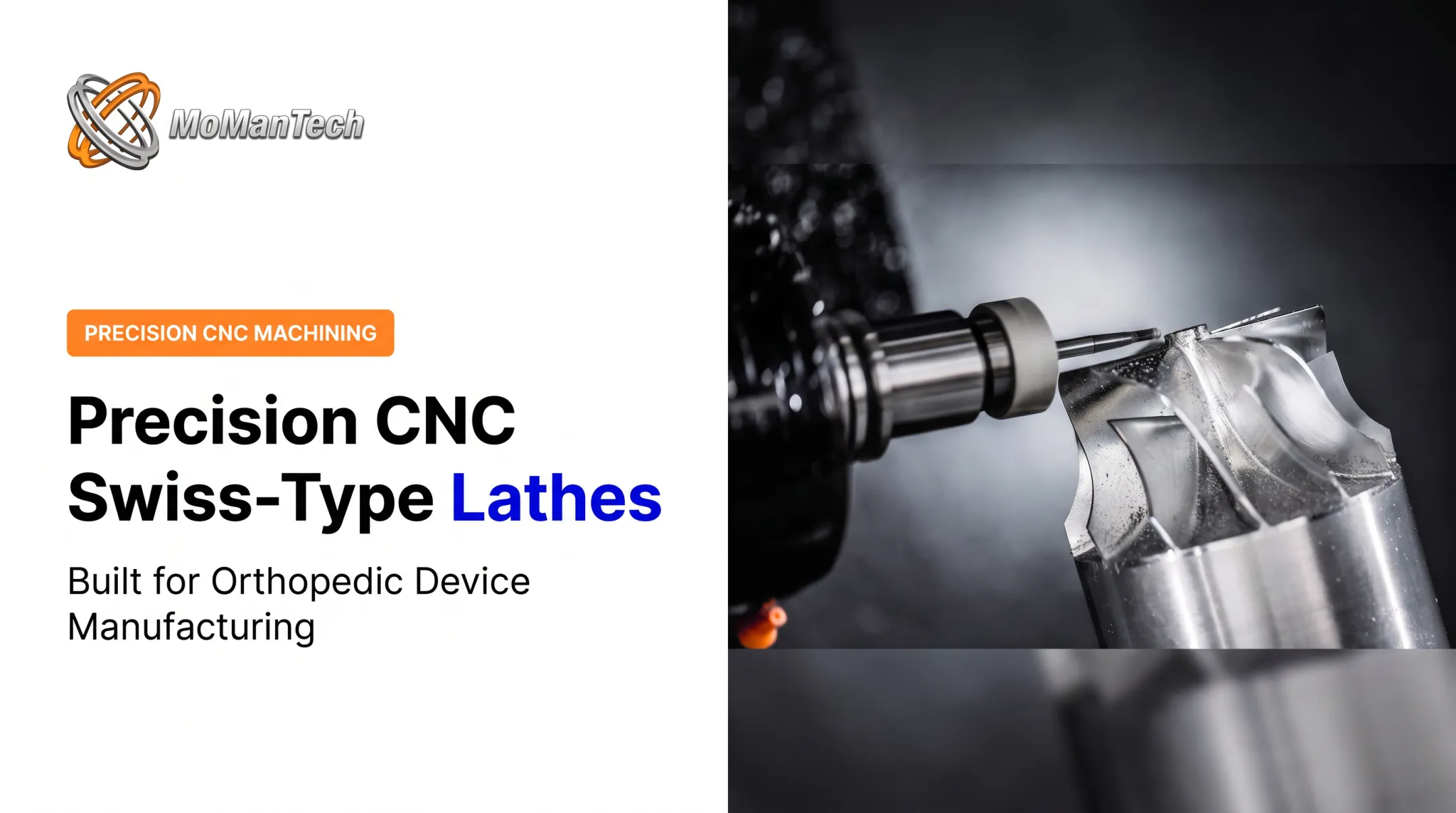
For orthopedic implants and instrumentation, CNC machining—including multi-axis milling, turning, Swiss lathe work, and wire EDM—is often the default. It supports tight tolerances and material traceability without locking a company into tooling before volumes exist.

Partners such as MoManTech use these same CNC and EDM methods for spinal, trauma, and extremity components at prototype through low-volume runs. Always verify tolerance and finish claims with your manufacturing partner before finalizing a design.
Additive Manufacturing
3D printing earns its place when quantities are very small, geometries are complex, or eliminating tooling matters more than hitting the lowest possible unit cost. It's especially useful for fixtures, prototypes, and early design iterations.
For regulated medical-device components, material properties need real scrutiny before printing moves from prototyping into production.
FDA guidance on additive-manufactured devices recommends evaluating build orientation, part location, powder reuse, and final-state mechanical testing after post-processing, rather than testing raw material alone.
Injection Molding and Rapid Tooling
When plastic parts repeat and design is stable, molding can beat pure machining on unit cost—but only after you weigh mold design, tooling spend, and design lock-in.
Protolabs positions prototyping molds for expected lifetime volumes under 2,000 parts, with a lower tool price but higher per-part cost versus steel tooling for larger runs. Rapid or "soft" tooling bridges pilot and early production. Confirm current tooling cost and lead times with your supplier rather than borrowing figures from unrelated industries.
Casting, Sheet Metal, and Other Fabrication
Other fabrication routes fill gaps CNC and molding leave open:
- Casting — metal geometries and alloys such as cobalt-chromium and stainless steel, including orthopedic instrument handles
- Sheet metal — enclosures, brackets, and formed components
Choose based on function and inspection needs, not whichever quote comes back lowest.
Secondary Operations and Finishing
Primary machining is only part of the schedule. Plan secondary work up front:
- Deburring, cleaning, and passivation
- Heat treatment and coating
- Assembly and final inspection
Each step adds cost and lead time, so treat finishing as part of the production plan—not an afterthought.
How to Choose the Right Low-Volume Manufacturing Approach
Start with a practical sequence rather than picking a process by instinct:
- Define current and projected quantity — not just today's order, but where volume is headed over the next 12-24 months.
- Identify the product lifecycle stage — early validation, pilot, bridge, or established repeat production.
- Confirm material and functional requirements — what the part must withstand in actual use.
- Map critical dimensions — which tolerances are truly critical versus nice-to-have.
- Establish the delivery date — lead time often narrows your options more than cost does.

A design-for-manufacturability (DFM) review before production starts can cut unnecessary complexity, flag hard-to-reach features, loosen tolerances that do not need to be drawing-tight, and simplify fixturing. That step alone often prevents costly rework later.
Illustrative example: A precision metal instrument with tight tolerances usually points to CNC machining or wire EDM. A spinal or trauma component moving from pilot into bridge production may stay on CNC while volumes are still modest. A handful of prototype units for surgeon feedback often makes the most sense as 3D-printed parts. These are examples, not universal rules. Your geometry and material still decide the path.
What Should Appear in a Quote
A complete low-volume quote should break out:
- Programming, setup, fixtures, and tooling
- Raw material
- Machining or cycle time and labor
- Secondary operations and finishing
- Inspection and documentation
- Packaging, shipping, and rework risk
Unit price alone tells you almost nothing. Compare suppliers on:
- Total delivered cost and lead time
- Quality capability and inspection rigor
- Engineering support and response to design changes
- Minimum order quantity and room to scale later
Quality, Supplier Selection, and Scaling
Low-volume doesn't mean low-rigor. Expect the same process discipline at any quantity:
- Defined specifications and controlled processes
- First-article or initial inspection
- Traceability and nonconformance handling
- Documented inspection results for every batch
These are general best practices. Confirm which specific regulatory requirements apply to your product and supplier arrangement separately.
Why Quality Systems Matter for Medical-Device Programs
For orthopedic programs, working with an ISO 13485:2016-certified manufacturing partner matters. That certification signals a quality management system built to catch problems before parts ship. Partner-system certification is not the same as certification of your specific product; that distinction matters when you prepare regulatory documentation.
Supplier Selection Checklist
When evaluating a low-volume manufacturing partner, look for:
- Relevant industry and component experience
- Design-for-manufacturability support
- In-house inspection capability, not just outsourced testing
- Material and process control documentation
- Clear, responsive communication
- Capacity for current orders and future growth
- Confidentiality practices for unreleased designs
- A defined change-management process
- References you can independently verify
Planning for Scale
Before scaling up, confirm that your current process, design, and inspection approach can actually support higher demand without forcing an avoidable redesign or a drop in quality. Switching processes mid-program is expensive; planning for it early is not.
A partner already set up for low-volume orthopedic work makes that path easier. MoManTech is a Sheridan, Montana-based contract manufacturer focused exclusively on orthopedic medical-device components: spine, trauma, large joint, and foot-and-ankle.
The company is ISO 13485:2016-certified and supports prototype quantities of 1-10 units through production runs of 100-plus. Capabilities include precision CNC milling and turning, multi-axis Swiss lathe work, wire EDM, and metal and composite 3D printing.
Design-for-manufacturability consultation happens during planning. Every component is inspected before it leaves the facility using CMM and vision-based equipment.

Before requesting a manufacturing review or quote from any low-volume partner, prepare:
- Drawings and 3D models
- Material specifications
- Quantity forecasts
- Tolerance requirements
- Inspection expectations
- Target delivery dates
Having this ready up front shortens the quoting process and surfaces design issues before they become production problems.
Frequently Asked Questions
What is low-volume manufacturing?
Low-volume manufacturing produces a limited quantity of parts without dedicated high-volume tooling. Thresholds vary by industry and process, and it differs from one-off prototyping (far smaller quantities) and mass production (dedicated tooling and automation).
What does high-volume manufacturing mean?
High-volume manufacturing produces large quantities of standardized products using repeatable, highly optimized processes, dedicated tooling, and often automation. Per-unit costs drop significantly as volume scales up.
What is a CNC manufacturer?
A CNC manufacturer uses computer numerical control equipment, such as mills and lathes, to produce parts directly from digital designs. CNC machining is common for precise low-volume components because it skips the tooling investment required by molding or casting.
What are examples of discrete manufacturing?
Discrete manufacturing produces identifiable, countable units or assemblies rather than bulk material. Examples include medical devices, automotive components, aerospace parts, industrial equipment, and consumer electronics.
How do you choose a low-volume manufacturing partner?
Look for process expertise, quality systems, inspection and documentation capability, and clear responsiveness on lead time. Also weigh total delivered cost, minimum order quantities, and whether the supplier can support your future production volume.
Can low-volume manufacturing support medical-device production?
Yes—when the manufacturer runs ISO 13485-aligned quality controls, documentation, inspection, and materials expertise for medical devices. That coverage spans prototypes, first articles, pilot builds, and ongoing repeat production.